Developer Tools●●●Banger
What Is Decision Guardian?
Markdown-driven decision surfacing with Trie-based matching outperforms Slack threads.
Solve My ProblemBig Brain
poor_husteler
103mo ago
Shift from passive documentation to active enforcement.
CODEOWNERS for architectural decisions—surfaces why code exists before breaking it.
Engineering teams and technical leads managing architectural decisions across projects
CODEOWNERS (GitHub native, but for file ownership not decisions) · Documenting ADRs + manual enforcement (no automation) · Slack thread-based decision logging (unstructured, context-loss at scale)
The problem: A senior engineer made a deliberate choice—Postgres over MongoDB for billing because we needed ACID compliance. They documented the reasoning in a Slack thread. 8 months later they left. A new developer opened a PR to migrate to MongoDB. No one remembered why Postgres was chosen. We spent 3 months re-evaluating a decision that had already been carefully made.
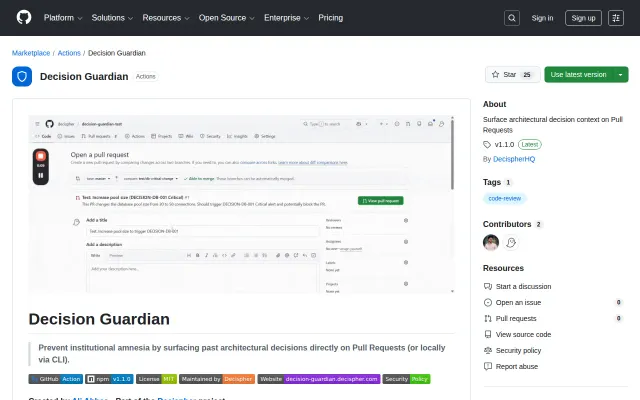
What this does: Decision Guardian is a GitHub Action that lets you write architectural decision records in markdown, tied to file paths. When a PR modifies those files, it automatically posts a comment with the relevant context—what was decided, why, what alternatives were rejected.
Think of it as CODEOWNERS for the "why" instead of the "who."
Technical details:
1) Written in TypeScript, runs as a GitHub Action 2) AST-based markdown parsing with remark 3) Prefix trie for O(log n) file-to-decision matching instead of brute-force O(N×M) 4) Supports glob patterns, regex content matching (with ReDoS protection via VM sandbox + timeout), and boolean logic for complex rules 5) Handles PRs with 3000+ files using streaming mode 6) Idempotent comments—updates existing ones instead of spamming, with self-healing duplicate cleanup 7) 5-layer progressive truncation to always fit within GitHub's comment size limit 8) No external network calls, no data leaves your GitHub runner
What I'd love feedback on:
1) Is the decision file format (structured markdown) the right choice, or would YAML/TOML be better? 2) Any thoughts on content-based matching (detecting patterns in diffs, not just filenames)? 3) Would integration with existing ADR tools (like adr-tools) be useful?
Code: https://github.com/DecispherHQ/decision-guardian
Happy to answer any questions about the implementation.
Markdown-driven decision surfacing with Trie-based matching outperforms Slack threads.
Markdown ADRs automatically surface on PRs — prevents institutional amnesia at scale.
Auto-comments architectural context on PRs via GitHub Actions; solves real institutional knowledge loss.
Content-aware rule matching on diffs surfaces only relevant decisions, not noise.
Surfaces architecture context on PRs with O(log n) lookup, not just another lint rule.
Surfaces ADRs in PRs when protected files change, unlike static Log4brains.