Education●●●Banger
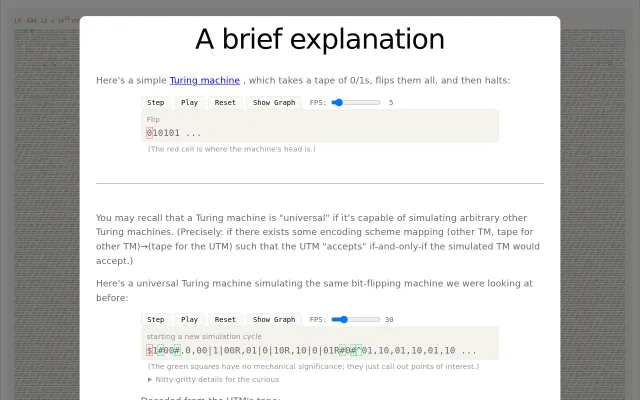
A Turing machine simulating a Turing machine simulating a...
UTM simulating itself where L3 won't execute its first step until the year 2070.
Rabbit HoleWizardryCozy
thingoptimizer
3124d ago
A Turing Machine that will perform a bubble sort on the tape input; compatible with turingmachine.io yaml format. Two variants of the Turing Machine are provided.
Bubble sort on a Turing Machine with 31 states; educational but purely academic novelty.
Computer science students, educators, theory enthusiasts learning Turing machines and formal computation
Standard CS theory textbooks (CLRS, Sipser) · turingmachine.io examples · Other CS education projects on GitHub
111011011111110101111101111
and give this output:
101101110111101111101111111
I.e., it's sorting the array [3,2,7,1,5,4]. The machine has 31 states and requires 1424 steps before it comes to a halt. It also introduces two extra symbols onto the tape, 'A' and 'B'. (You could argue that 0 is also an extra symbol because turinmachine.io uses blank, ' ', as well).
When I started writing the code the LLM (Claude) balked at using unary numbers and so we implemented bubble_sort.yaml which uses the tape symbols '1', '2', '3', '4', '5', '6', '7'. This machine has fewer states, 25, and requires only 63 steps to perform the sort. So it's easier to watch it work, though it's not as generalized as the other TM.
Some comments about how the 31 states of bubbles_sort_unary.yaml operate:
| Group | Count | Purpose | |---|---|---| | `seek_delim_{clean,dirty}` | 2 | Pass entry: scan right to the next `0` delimiter between adjacent numbers. | | `cmpR_*`, `cmpL_*`, `cmpL_ret_*`, `cmpL_fwd_*` | 8 | Comparison: alternately mark units in the right (`B`) and left (`A`) numbers to compare their sizes. | | `chk_excess_*`, `scan_excess_*`, `mark_all_X_*` | 6 | Excess check: right number exhausted — see if unmarked `1`s remain on the left (meaning L > R, swap needed). | | `swap_*` | 7 | Swap: bubble each `X`-marked excess unit rightward across the `0` delimiter. | | `restore_\*` | 6 | Restore: convert `A`, `B`, `X` marks back to `1`s, then advance to the next pair. | | `rewind` / `done` | 2 | Rewind to start after a dirty pass, or halt. |
(The above is in the README.md if it doesn't render on HN.)I'm curious if anyone can suggest refinements or further ideas. And please send pull requests if you're so inclined. My development path: I started by writing a pretty simple INITIAL_IDEAS.md, which got updated somewhat, then the LLM created a SPECIFICATION.md. For the bubble_sort_unary.yaml TM I had to get the LLMs to build a SPEC_UNARY.md because too much context was confusing them. I made 21 commits throughout the project and worked for about 6 hours (I was able to multi-task, so it wasn't 6 hours of hard effort). I spent about $14 on tokens via Zed and asked some questions via t3.chat ($8/month plan).
A final question: What open source license is good for these types of mini-projects? I took the path of least resistance and used MIT, but I observe that turingmachine.io uses BSD 3-Clause. I've heard of "MIT with Commons Clause;" what's the landscape surrounding these kind of license questions nowadays?
UTM simulating itself where L3 won't execute its first step until the year 2070.
Educational sorting visualizer using a custom teaching language instead of Python.
Sorting visualizer when Visualgo and dozens of alternatives already exist.
Genetic algorithms for icon sorting is a clever over-engineering win.
Spring-style config injection for Python when pydantic-settings already handles this.
Custom Python vBNG emulates ISP subscriber management without expensive hardware or proprietary software.