Developer Tools●Mid
Gas Town Control Plane – hosted monitoring for multi‑agent workspaces
Control plane for a niche orchestrator; zero adoption signal, unclear if Gas Town is viable.
Ship It
edgar_ortega
104mo ago
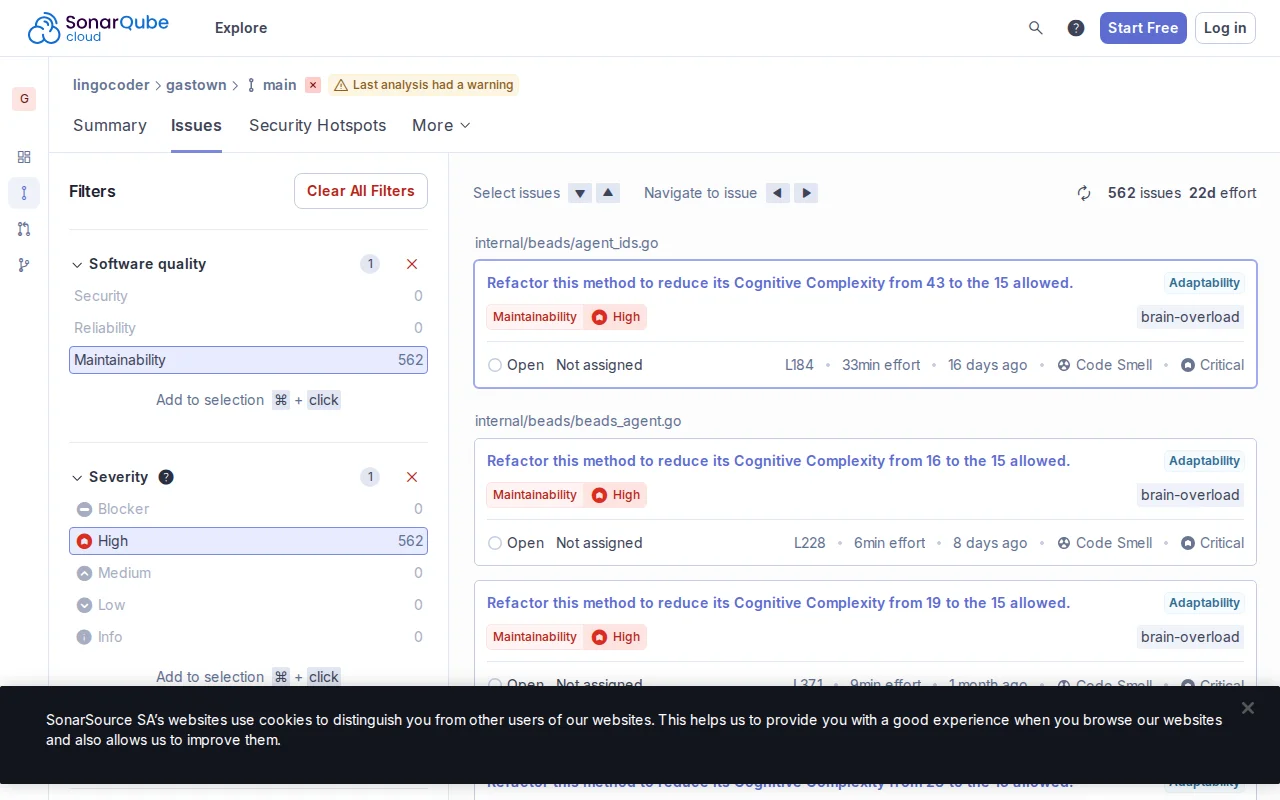
The author runs Gas Town through SonarCloud, dumps the maintainability results (the screenshot shows 562 high-severity issues) and pairs that with a humorous, brutally candid 'vibe' review — calling parts of the system a message bus 'built out of duct tape and string' and questioning odd tech choices like storing parsed colon-separated strings in a versioned DB. It's entertaining and instructive: useful reading if you want concrete examples of code smell flagged by static analysis, but it's commentary not a new tool.
Backend developers, maintainers, code-quality engineers, and anyone interested in technical critiques of open-source projects
I followed that up with — appropriately — a vibe code review [2]…
_______
…
Brutal Verdict:
You’ve built a message bus out of duct tape and string. It’s "Booch-like" only in the sense that you’ve abstracted the concept of a channel, but the _implementation_ is pure "boot-camp-grad-on-their-third-Red-Bull."
You are using a high-performance versioned database (Dolt) to store... manually parsed colon-separated strings. _Why?_
…
_______
Control plane for a niche orchestrator; zero adoption signal, unclear if Gas Town is viable.
Dashboard for Gas Town multi-agent monitoring, but Gas Town adoption is unproven.
Adversarial debate between models beats single-model groupthink, but crowded code-review space.
Bash wrapper around Claude API when CodeRabbit and Cursor already exist.
Git worktree isolation enables parallel AI sessions without merge conflicts.
Plan-mode plugin for Pi Coding Agent, but existing Claude Code version already exists.