Hardware●●●Banger
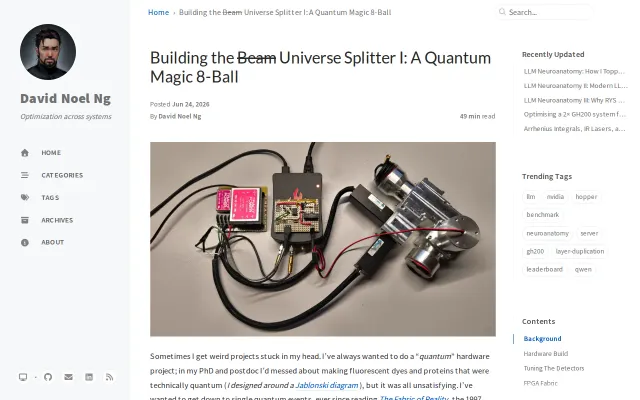
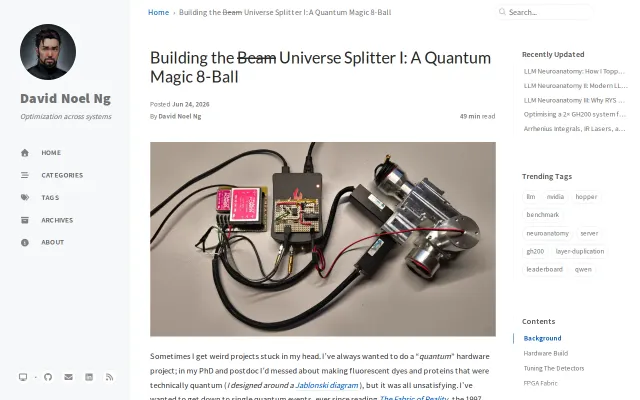
I built a hardware quantum RNG and wired it into a Magic 8-Ball
Single-photon beam splitter RNG with Many Worlds Interpretation themed Magic 8-Ball demo.
WizardryRabbit HoleBold Bet
dnhkng
1311mo ago
A Replacement for the C++ std. RNG Lib that employs SIMD
Cross-platform SIMD RNG library with AVX2/AVX-512 paths and zero dependencies.
C++ developers needing high-performance RNG
PCG · xoshiro · Random123
Repository: https://github.com/whisprer/c-simd-rng-lib/
The goal was to solve a practical gap:
Most high-performance SIMD RNG implementations are either:
academic prototypes
single-architecture
non-portable
incomplete
or not packaged for real deployment
This library provides:
• AVX2 / AVX-512 accelerated paths (with graceful fallback) • Deterministic, reproducible streams • Clean API surface • Zero external runtime dependencies • Works across Win / Linux / macOS • Production-ready build setup
In bulk generation scenarios it significantly outperforms std::mt19937 and standard <random> engines, and benchmarks competitively (or faster) than other SIMD-enabled RNG libraries.
A separate benchmarking repository contains:
• Full comparison suite • Competing library benchmarks • Throughput numbers • Architectural breakdowns • Methodology + raw results
Benchmark repo: https://github.com/whisprer/benchmark/
The focus is high-throughput generation for simulations, Monte Carlo, procedural systems, and statistical workloads where large batches matter more than single draws.
Interested in feedback from folks working in HPC, simulation, game engines, or scientific computing.
Single-photon beam splitter RNG with Many Worlds Interpretation themed Magic 8-Ball demo.
Beam splitter + PMT quantum RNG with FPGA debiasing, demoed via Magic 8-Ball.
Zero-allocation CSV iterator in Zig with SIMD—constraint craft for systems programmers.
Field iterator + zero alloc forces explicit ownership; SIMD scanning is clever but niche.
Swap software PRNG for hardware entropy in vLLM sampling, but niche use case with steep setup cost.
Fastest open-source SIMD Unicode normalization with SQLite-style single-header distribution.