Open Source●Mid
Linux Kernel Documentation Index-Every Page in the Linux Kernel's Docs
Curated index for kernel docs when docs.kernel.org already has search and navigation.
Niche Gem
tamnd
202mo ago
IPSet for strings: scalable pattern matching for packet payloads
558x faster pattern matching in the kernel using Aho–Corasick, handles fragmentation correctly.
Network security engineers, sysadmins managing high-volume firewall rules, kernel developers
xt_string (kernel native, O(N), what this replaces) · Suricata (userspace IDS, but different architecture)
xt_string scales linearly (O(N)), causing massive slowdowns with many rules. Strider uses Aho–Corasick for O(1) matching.
Key Features:
O(1) Algorithmic Complexity: Uses a compact, double-array trie-based Aho–Corasick automaton, sustaining above 1 Gbps when matching 3,000 patterns, while xt_string (KMP) drops below 2 Mbps.
Lockless Datapath: RCU-protected lookups ensure zero locking overhead on the packet processing hot path.
Correctness: Never misses patterns spanning across IP fragments (unlike xt_string’s fast Boyer–Moore mode).
Curated index for kernel docs when docs.kernel.org already has search and navigation.
LSM hooks block operations synchronously; most eBPF security tools only alert asynchronously.
Kernel changelogs finally readable without subsystem expertise or manual diff digging.
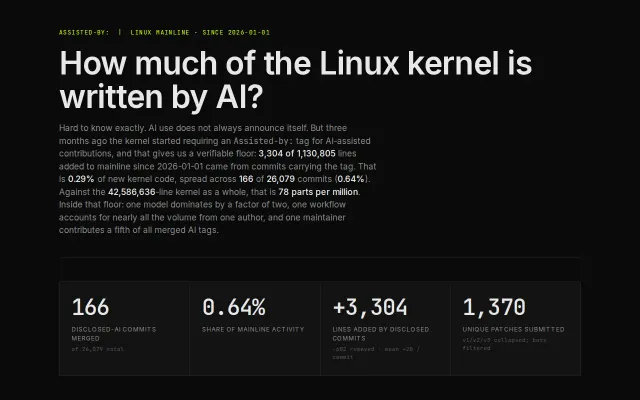
Verifiable floor of 0.29% AI code in the kernel using the new Assisted-by tag.
eBPF behavioral detection catches miners spoofing thread names without signature databases.
Linux fork claiming penetration-proof security, but proprietary userspace tools undermine auditability.