Productivity●●Solid
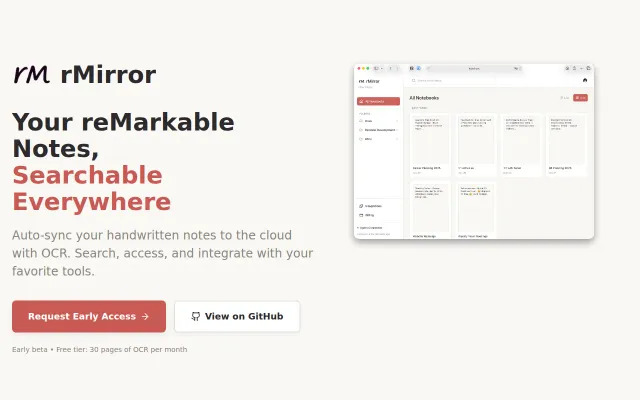
RMirror Cloud – Open-Source OCR and Notion Sync for ReMarkable Tablets
Claude-powered OCR for messy handwriting, but macOS-only and reMarkable's audience is niche.
Solve My ProblemNiche Gem
gottino
203mo ago
MCP server for accessing reMarkable tablet data
Bridges offline tablet notes into Claude's context—solves the second-brain connectivity gap.
reMarkable tablet users, developers using Claude Code, knowledge workers integrating note-taking with AI
Obsidian Canvas · Roam Research integrations · Notion AI
So I built an Open Source MCP server that connects to the reMarkable Cloud API and gives AI assistants (Claude Code, OpenClaw, etc) read-only access to your entire library.
What it does:
- Read notebooks, PDFs, and ebooks with full text extraction - Full-text search across your library (SQLite FTS5 index) - Render pages as PNG/SVG — useful for hand-drawn diagrams and wireframes - Handwriting OCR using the client's own LLM via MCP sampling (no external API keys needed)
Setup is super easy using the following command:
curl -fsSL https://thijsverreck.com/setup.sh | sh
It installs dependencies, registers your tablet, and configures both Claude Code andClaude Desktop. The server runs via uvx and auto-updates on each launch.
Built with Python, runs on the MCP protocol so it works with any compatible client. Everything is read-only — it never writes to your tablet.
Would love feedback, especially from other reMarkable users who've been wanting better integration with their dev workflows.
Claude-powered OCR for messy handwriting, but macOS-only and reMarkable's audience is niche.
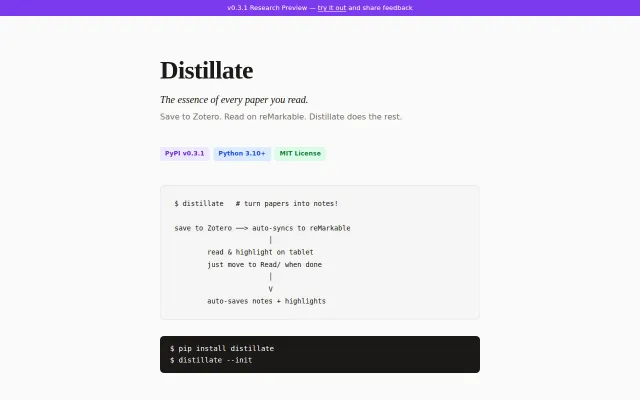
Bridges three tools academics already own, zero cloud lock-in, extracts highlights via wire protocol parsing.
Claude memory without token costs, but requires running five services for one feature.
Uses official WhatsApp Cloud API instead of reverse-engineering—safe integration with stateless polling.
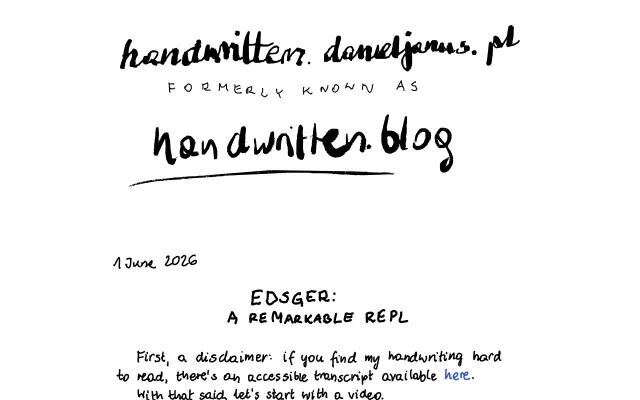
Clojure REPL that actually matches the reMarkable's handwritten input paradigm.
Runs extraction and search server-side so your local MCP is a tiny HTTP client — no local DBs, no giant RAM leaks, and an easy npx install and .mcp.json or global MCP registration. It exposes clear tools (save_memory, recall_memories, extract_memories, get_project_context) and adds project-scoped + global preferences — a pragmatic fix for Claude Code's tiny flat-file memory. The tradeoff is obvious: usefulness depends on the hosted API (privacy, uptime, cost), and the repo looks early-stage with minimal commits and docs beyond the quickstart.