Developer Tools●●Solid
O-O – HTML/bash polyglot files that rewrite themselves (update)
Self-rewriting HTML/bash files with CSS sync—clever constraint hack, niche appeal.
WizardryCozyZero to One
jahala
203mo ago
Self-updating articles concept using polyglot html/bash files. No server, no db. The file is the app.
Polyglot HTML-bash self-updating docs that run Claude to research and edit in-place.
Content creators, researchers, and developers who want living documents without infrastructure.
So .. No server, no database, no build step. The file is the "app".
Each .o-o.html file is a polyglot — valid HTML and valid bash. Open it in a browser to read a formatted article with TOC, citations, and images. Run it with bash to have an AI agent research the web and rewrite the article in-place with fresh information.
open article.o-o.html # read it
bash article.o-o.html # update it
Every document embeds an update contract — a JSON block that tells the agent what to research, which sections to maintain, what sources to trust, and how much to spend. The agent reads the contract, searches the web, and surgically edits only the <article> content, manifest, and source cache. The shell never sees the article text.
```
bash index.o-o.html --new <-- create your own article
bash your-article-title.o-o.html <-- populate / update the article
bash index.o-o.html --update-all <-- update and index all articles in the filder
```
The index file doubles as a library manager — it generates new documents from a template and batch-updates stale ones.
Requirements: bash 3.2+ and the Claude Code CLI. No Python, Node, or jq.
Self-rewriting HTML/bash files with CSS sync—clever constraint hack, niche appeal.
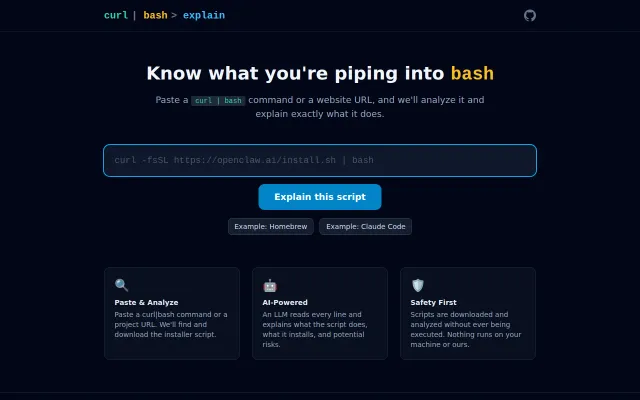
curl|bash analysis without execution, but ChatGPT explanations are inconsistent and scripts often obscured.
Bash wrapper around Claude API when CodeRabbit and Cursor already exist.
LLM-generated selector caching beats manual scraping, but Jina AI and Beautiful Soup handle this cheaper.
Bash script orchestration for AI agents is clever but the space is getting crowded fast.
Automates function-to-script promotion, but solves a narrow workflow friction point.