Security●●Solid
A Mutating Webhook to automatically strip PII from K8s logs
Distroless sidecar with entropy analysis beats regex filters on CPU usage.
Solve My ProblemNiche Gem
aragoss
2532mo ago
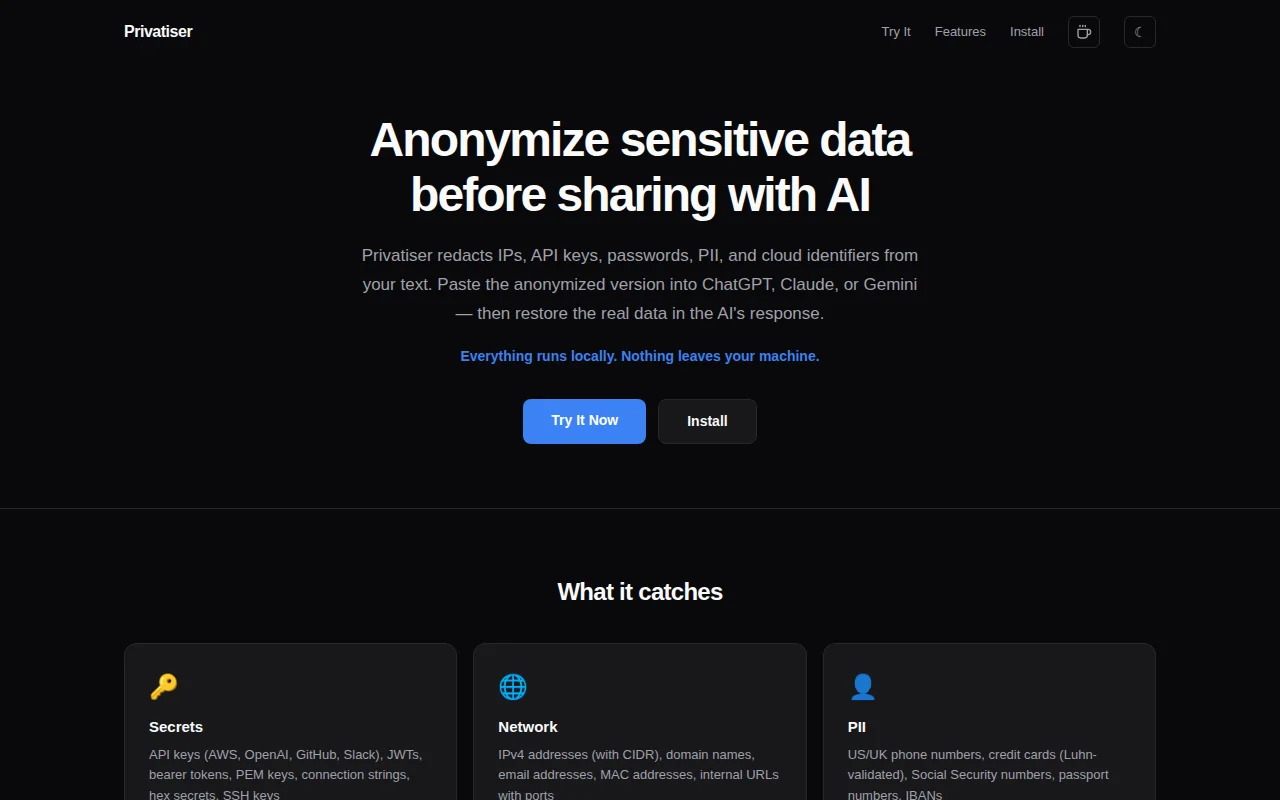
Consistent, reversible pseudonymization with a downloadable mapping is the feature that actually makes this usable — you can paste anonymized text into ChatGPT and restore everything with one click. Shipping a browser extension that auto-anonymizes/pastes and a CLI/Python library for pipelines shows the author thought about real workflows. It relies on pattern-based detection and will miss exotic formats, but the local-only model and restore UX are a practical win.
Backend developers, DevOps/SREs, security-conscious engineers and support staff who paste logs/configs into AI assistants
It detects and replaces sensitive values with consistent pseudonyms — so the AI can still reason about your text (e.g., "these two servers share the same IP") without seeing the real data. Then you paste the AI's response back and restore everything with one click.
What it catches: API keys (AWS, OpenAI, GitHub, Slack, etc.), JWTs, bearer tokens, SSH keys, connection strings, IPs, domains, emails, phone numbers, credit cards, SSNs, AWS ARNs/account IDs, Azure/GCP identifiers, UUIDs, and 200+ keyword-based patterns for passwords, hostnames, usernames, database names, etc.
It also understands natural language context — "password is secret123" and "host set to prod-db.internal" both get caught, not just key = "value" syntax.
Everything runs locally in your browser. No servers, no telemetry. Available as a Chrome/Firefox (Firefox is currently pending review) extension and a web tool.
Would love feedback on patterns you'd want added or things it misses.
Distroless sidecar with entropy analysis beats regex filters on CPU usage.
Yet another PII redaction proxy when Lakera and Portkey already dominate this space.
Multi-model LLM router with semantic cache, but caching+fallback already exist (Anthropic, LangSmith, Unify).
Temporary decryption with ctg run deletes plaintext after command, unlike sops or git-crypt.
Eight years of maintenance but privnote and 1Password already solve this.
Local PII redaction for ChatGPT, but dozens of prompt guardrails exist already.