Developer Tools●●Solid
PDF 2 Context – Convert PDF text to JSONL files
Go CLI with built-in OCR fallback when JinaAI and Firecrawl already handle this.
Ship ItSolve My Problem
vegancap
401mo ago
Let LLMs see your codebase just like you do.
DeepSeek-OCR–inspired visual tokenization saves 40% tokens vs text, with academic validation.
Backend developers, AI researchers, prompt engineers using multimodal LLMs
Continue · Cursor · Codeium
I've been experimenting heavily with large-context multimodal LLMs (like Gemini 3 Pro) for coding tasks. I noticed that feeding raw text files consumes a massive amount of tokens and often clutters the context window.
Inspired by recent research (like the DeepSeek-OCR paper) suggesting visual encoders can be more efficient than text tokenizers for structured data, I built pixrep.
It’s a CLI tool that converts your codebase into a structured, syntax-highlighted PDF hierarchy.
Key features: - Token Efficiency: In my local benchmark, a repo requiring ~31k text tokens was compressed to ~19k tokens when fed as a visual PDF (using the `onepdf` mode). - Semantic Minimap: It uses Python's `ast` (and regex for other langs) to generate a UML/call-graph minimap at the top of each file. - Linter Heatmap: It can run `ruff` or `eslint` and overlay a heatmap on the PDF to warn the LLM about risky lines visually. - OnePDF Mode: Packs the core code into a single, ASCII-optimized PDF file for single-shot uploading.
It's written in Python and uses ReportLab for PDF generation.
I'd love to hear your thoughts on "Visual RAG" or any feedback on the implementation!
Go CLI with built-in OCR fallback when JinaAI and Firecrawl already handle this.
Obsidian-specific output with wikilinks and frontmatter beats generic markdown converters.
TTS wrapper for blogs when Speechify and NaturalReader already exist.
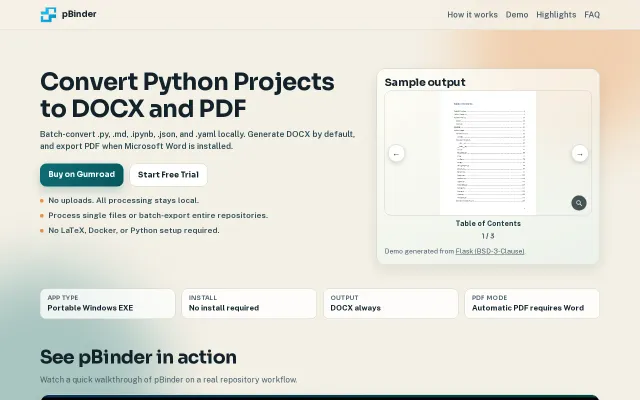
Offline Python codebase printing with hyperlinked cross-references, Windows-only.
Offline-first browser converter, but remove.bg and CloudConvert already own this space.
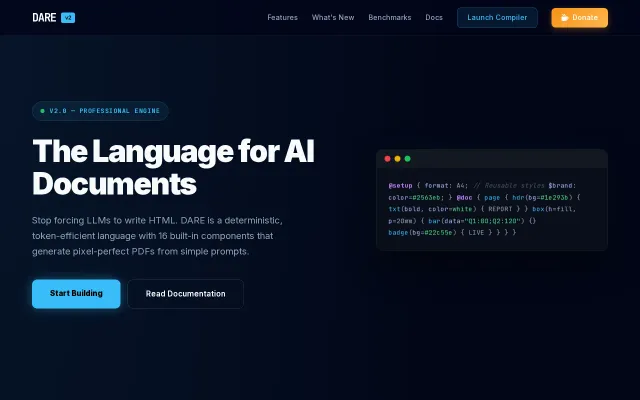
10x token efficiency + pixel-perfect determinism fixes LLM PDF generation without the HTML chaos.