Developer Tools●●Solid
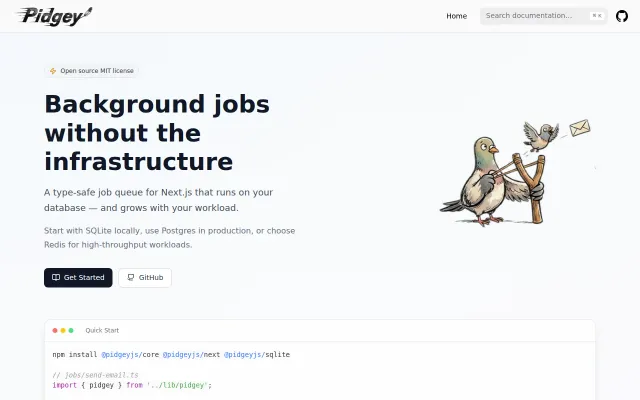
Pidgey – A type-safe job queue for Next.js that runs on your database
SQLite for local dev without Redis, but Trigger.dev and Inngest already own this space.
Solve My ProblemNiche Gem
jake_lazarus
202mo ago
High-performance message queue for Node.js — Valkey/Redis Streams with Rust-native NAPI bindings
BullMQ replacement hitting 48k jobs/s via 1-RTT ops and Rust native bindings.
Backend engineers building high-throughput systems on Node.js; teams already using Redis/Valkey at scale.
BullMQ · RabbitMQ · Bull
I'm a maintainer of Valkey GLIDE (the official Valkey client) and work on the AWS ElastiCache team. Day job is deep in database client internals — which gives me a clear view of where Node.js job queues hit a ceiling at scale.
The problems with queues like BullMQ aren't subtle: 3+ round-trips per operation, Lua EVAL scripts that NOSCRIPT-error on restart, Lists/BRPOPLPUSH primitives that predate Streams, and complete blindness to cloud topology (cross-AZ bills sneak up on you).
So I built Glide-MQ. High-performance job queue for Node.js built on Valkey/Redis OSS Streams, powered by Valkey GLIDE — a Rust core exposed via native NAPI bindings.
Because I maintain the underlying client, I could go further than an external library ever could:
1-RTT per job — completeAndFetchNext folds completion + next fetch + activation into a single FCALL. No more chatty round-trips.
Server Functions over EVAL — one FUNCTION LOAD, persistent across restarts. NOSCRIPT errors gone entirely.
Streams + Consumer Groups from day one — replaced Lists/BRPOPLPUSH. The PEL gives at-least-once delivery with fewer moving parts.
Cluster-native, not cluster-bolted — hash-tagged keys from day one. No {braces} surprise when you scale out.
AZ-Affinity routing — reads go to same-AZ replicas. Up to 75% reduction in cross-AZ costs on ElastiCache.
Batch API pipelining — addBulk for 1,000 jobs: 228ms to 18ms (12.7x) via GLIDE's non-atomic pipeline.
IAM auth — native ElastiCache/MemoryDB auth with auto token refresh. No secrets in env vars.
Numbers (no-op processor, Valkey 8.0, single node): - c=1: 4,376 jobs/s | c=10: 15,504 jobs/s | c=50: 48,077 jobs/s - 15KB payload compressed to 331 bytes (98% savings)
Also included: transparent gzip (zero config), OpenTelemetry tracing, TestQueue/TestWorker in-memory backend for unit tests without running Valkey, and chain()/group()/chord() for job pipeline workflows.
Companion package: @glidemq/dashboard — drop createDashboard([q1, q2]) into any Express (or any other framework) app and get a live REST + SSE UI across all your queues (avifenesh/glidemq-dashboard on GitHub).
Would love brutal testing on it abilities — especially from anyone burned by queue scaling in production.
SQLite for local dev without Redis, but Trigger.dev and Inngest already own this space.
TUI and web dashboard for ARQ when the library has no built-in monitoring.
Fencing tokens + lease expiry races caught with deterministic test harness—correctness, not just convenience.
Ditches Redis entirely by leveraging Postgres LISTEN/NOTIFY for instant wakeups.
Job queue that eliminates Redis/RabbitMQ by storing state in a single JSON file with CAS.
Job queue without a separate broker—uses Postgres LISTEN/NOTIFY and SKIP LOCKED.