Developer Tools●●Solid
QueryPad – Browser SQL Playground for CSV, JSON, and Parquet Files
DuckDB-Wasm runs SQL queries on dropped files directly in your browser, no server needed.
CozySlick
kiyeonjeon
112mo ago
A command-line tool for querying CSV, JSON, and Avro files using pipe-based syntax
jq for tables: pipe-based querying across CSV, JSON, Avro, Parquet in one tool.
Data engineers, backend developers who work with data files from terminal
jq (for JSON) · DataFusion CLI · DuckDB CLI
A while ago I had this idea of a simple pipe-based CLI tool, like jq but for tabular data, that works across all these formats with a consistent syntax. I refined the idea over time into something I wanted to be genuinely simple and useful -- not a full query engine, just a sharp tool for exploration and debugging. I never got around to building it though. Last week, with AI tools actually being capable now, I finally did :)
I deliberately avoided SQL. For quick terminal work, the pipe-based composable style feels much more natural: you build up the query step by step, left to right, and each piece is obvious in isolation. SQL asks you to hold the whole structure in your head before you start typing.
`dq 'sales.parquet | filter { amount > 1000 } | group category | reduce total = sum(amount), n = count() | remove grouped | sortd total | head 10'`
How it works technically: dq has a hand-written lexer and recursive descent parser that turns the query string into an AST, which is then evaluated against the file lazily where possible. Each operator (filter, select, group, reduce, etc.) is a pure transformation -- it takes a table in and returns a table out. This is what makes the pipe model work cleanly: operators are fully orthogonal and composable in any order.It's written in Go -- single self-contained binary, 11MB, no runtime dependencies, installable via Homebrew. I'd love feedback specially from anyone who's felt the same friction.
DuckDB-Wasm runs SQL queries on dropped files directly in your browser, no server needed.
DuckDB-Wasm in browser with shareable URLs—better than opening Python.
SQL queries on CSV streams—instant, zero-setup alternative to awk and sqlite3 boilerplate.
1.3MB WASM database beats DuckDB 5x on 10M row analytics, runs in Cloudflare Workers.
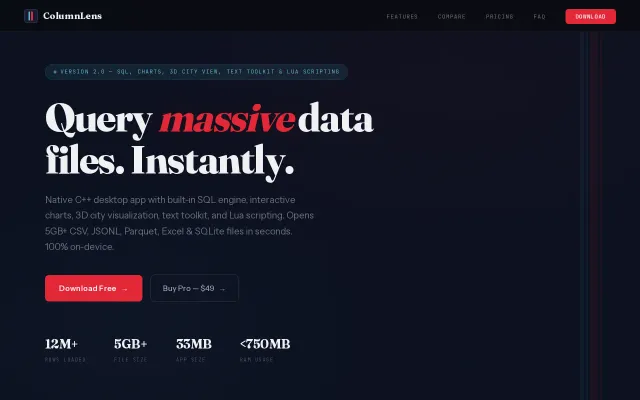
DuckDB-powered desktop app queries 5GB CSVs locally in seconds without cloud uploads.
Adapter protocol routes queries to DuckDuckGo, Brave, or Exa—JSON piping done right.