Data●Mid
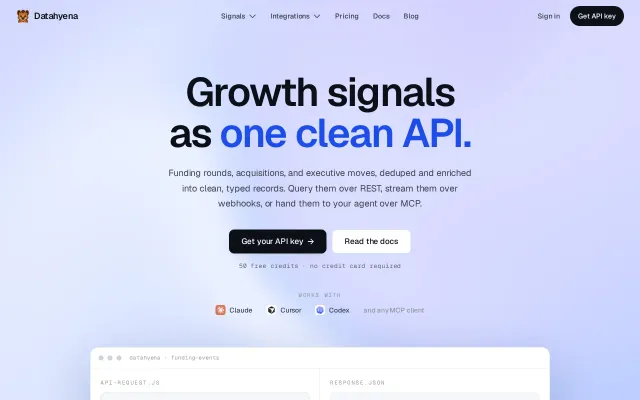
DataHyena – Growth signals as one clean API
Yet another growth data API competing with Crunchbase and PitchBook.
Slick
ghostfoxgod
101mo ago
EEGFrontier is an open-source EEG device designed to measure focus and attention during study using real brain signals. It uses a custom-built PCB with a professional EEG analog front-end to capture raw EEG data and stream it in real time to a computer via USB.
Full-stack open EEG hardware with analog front-end beats black-box consumer devices for learning.
Neuroscience students, EEG researchers, DIY biohacking enthusiasts, cognitive science labs
Muse headband (consumer) · OpenBCI Cyton (competitor open-source) · BioAmp EXG Pill (educational platform)
I built EEGFrontier, a compact open-source EEG acquisition board based on the ADS1299 and an RP2040.
The goal was to design a low-cost board that works with dry electrodes while exposing the full EEG signal chain — no abstractions, no closed firmware.
What surprised me most during this project were the practical issues that datasheets don’t really prepare you for: grounding (REF/BIAS), noise coupling from digital lines, routing constraints, and how small layout decisions drastically affect signal quality.
The repository includes full KiCad files, firmware, a BOM with cost references, and documentation images. This is a V1 board and already works, but I’m actively iterating on shielding and noise mitigation.
I’d really appreciate feedback from people with experience in EEG, biosignals, or analog front-end design — especially criticism.
Yet another growth data API competing with Crunchbase and PitchBook.
Smart hysteresis compaction for Claude Code, but limited to single API and not a general problem.
Browser-based EEG analysis testing golden ratio brain coherence with peer-reviewed preprint backing.
Contactless REM detection validated against clinical EEG without wearing electrodes.
Black-body radiation color mapping makes fake embers actually convincing.
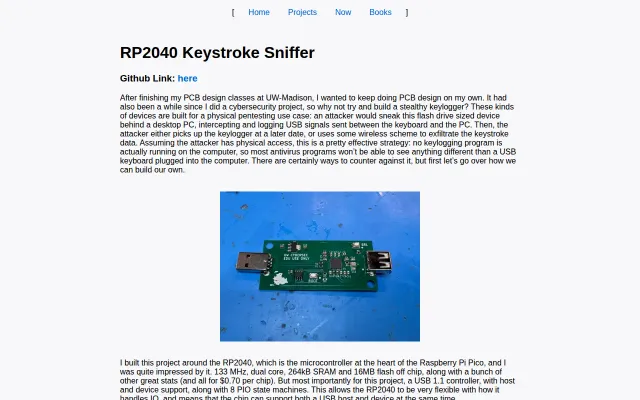
Dual-core RP2040 bit-banging USB host and device simultaneously is a neat hardware hack.