Security●●Solid
Secret-keystore – KMS-encrypted .env that never touches process.env
KMS encryption that keeps secrets out of process.env entirely.
Big BrainSolve My Problem
faiz_ahmed
101d ago
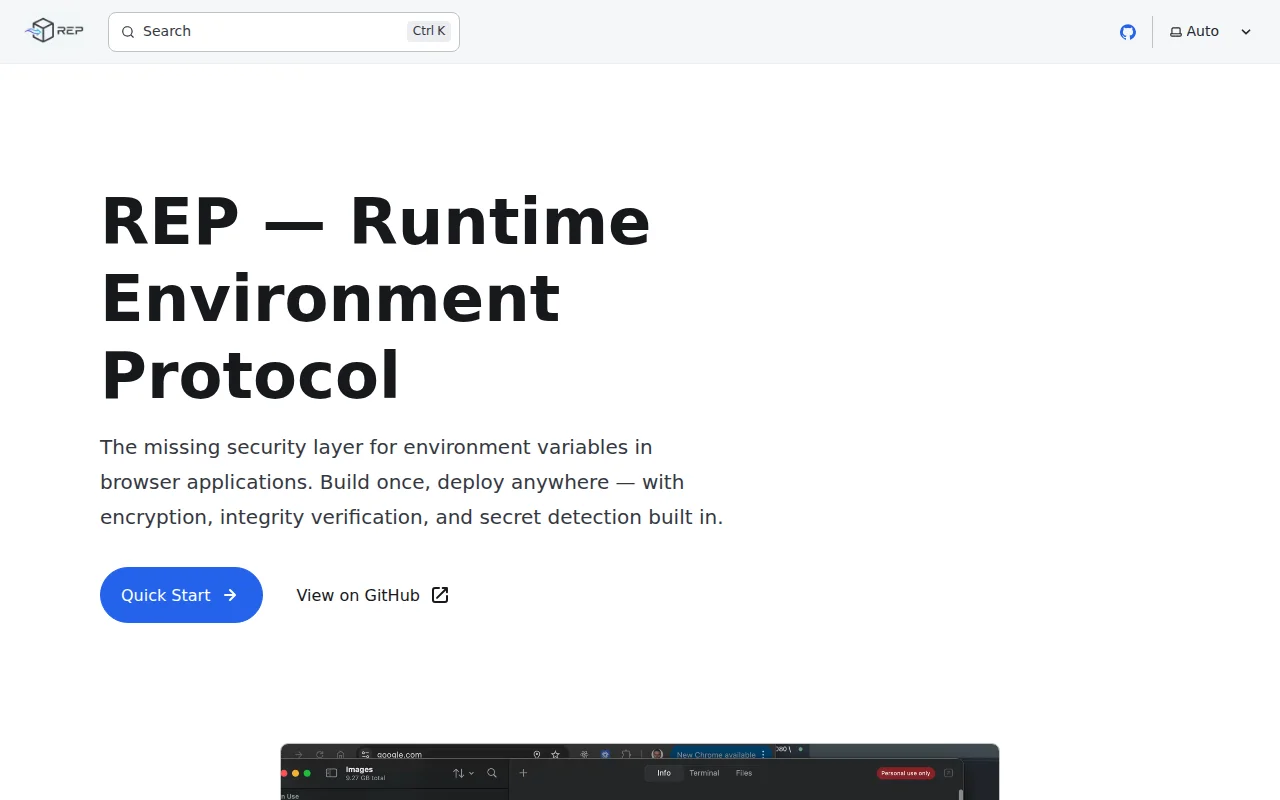
Finally fixes the frontend environment variable problem: one Docker image, any config, encrypted secrets at runtime.
Backend / DevOps engineers deploying containerized frontend applications with environment-specific secrets
Doppler · HashiCorp Vault · Sealed Secrets (Kubernetes)
Every frontend framework bakes environment variables into the JavaScript bundle at build time (process.env, import.meta.env). This means your Docker image is environment-specific — you build one for staging, another for prod, and the image you tested is never the one you deploy.
I built REP (Runtime Environment Protocol) to fix this. It's a lightweight Go gateway (~6MB binary, zero deps) that sits in front of your static file server and injects env vars into HTML responses at container startup.
What makes it different from the dozens of window.__ENV__ hacks:
- Three-tier security classification: REP_PUBLIC_* (plaintext), REP_SENSITIVE_* (AES-256-GCM encrypted, decrypted via short-lived session key), REP_SERVER_* (never reaches the browser)
- Automatic secret detection — scans PUBLIC vars for high-entropy strings, AWS keys, JWTs, etc. and refuses to start in strict mode
- HMAC integrity verification on every payload
- Optional hot config reload via SSE
- Works with any SPA (React, Vue, Svelte, Angular, vanilla) — no build tool plugins
- FROM scratch compatible — the binary is all you need
The SDK is ~1.5KB gzipped and gives you synchronous access (rep.get('API_URL')) for public vars and async decryption (await rep.getSecure('KEY')) for sensitive ones.
Full RFC-style spec, security threat model, and reference implementation: https://rep-protocol.dev
I'd especially love feedback on the security model — I've tried to be honest about what the SENSITIVE tier actually protects against vs what it doesn't. The threat model doc doesn't pretend browser-side encryption is bulletproof.
Built this because I got tired of watching every team I've worked with reinvent the same env.sh → window.__ENV__ hack with zero security thought behind it.
KMS encryption that keeps secrets out of process.env entirely.
Runtime injection bypasses .env files entirely—secrets never touch disk.
Another OpenAPI-to-UI generator in a space dominated by Retool and Swagger.
Explicit lifecycle teardown prevents memory leaks better than React effects or Vue watchers.
The visual concept is strong: generous negative space, a micro-typographic centerline and restrained UI that actually sells the idea of 'ma'. Unfortunately the page reads like a demo/theme — repeated copy blocks and zeroed stats suggest placeholder content rather than a finished system or component library. Useful as a quiet starting point for designers who like minimalism, but it needs real docs, components and examples to move beyond a pretty landing.
Another reactive JS library in a sea of Solid, Svelte, and Preact.