Productivity●●Solid
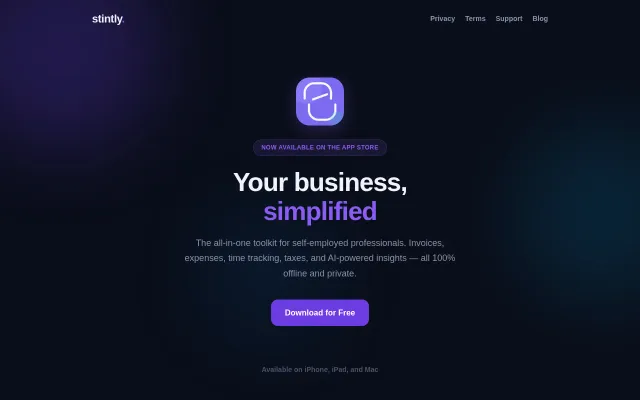
Stintly – Offline-first app for freelancers with on-device AI
Privacy-first competitor to FreshBooks/Wave, but offline app market is crowded despite good execution.
Solve My ProblemSlickNiche Gem
ryanfielding
103mo ago
WebRTC peer sync without a server, but local-first finance is well-trodden territory.
Privacy-conscious individuals managing personal finances across multiple devices
Actual Budget · YNAB · GnuCash
The constraint: Two devices need to share an expense ledger, but I don't want to run a database. No Postgres, no Firebase, no Supabase. The user's financial data should never leave their devices.
Storage: IndexedDB only
Every transaction lives in IndexedDB. Schema has 7 object stores — transactions, version history, device identity, pairings, sync state, recurring templates, and alerts. Performance is fine at personal finance scale (thousands of records). I added a simple query cache layer on top to avoid redundant reads — nothing fancy, just memoization with timestamp invalidation.
Sync: WebRTC DataChannel, no relay
Two devices pair using a 4-digit code. A signaling server exchanges ICE candidates and SDP offers — that's all it does. Once the WebRTC DataChannel opens, transactions sync as small JSON payloads directly between devices. The signaling server never sees transaction data.
TURN fallback is there for NAT traversal edge cases, but in practice most connections establish peer-to-peer on the first try.
Conflict resolution:
Both devices can edit the same transaction offline. Every edit creates a version entry. On sync, conflicts resolve using a version vector — latest timestamp wins, but both versions are preserved in history so nothing is lost. Simple but sufficient for a two-device household.
Voice pipeline (the fun part):
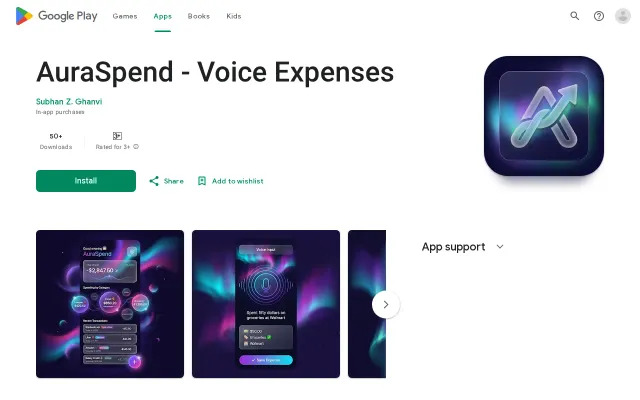
Users can speak an expense instead of typing it. Audio goes to a speech-to-text API, then the transcript goes to Gemini Flash with a structured output schema (Zod-validated). It extracts amount, category, payment method, and date from natural language. Accuracy is surprisingly good — the model handles ambiguous input like "lunch with coworkers, split three ways, I paid 1500" correctly.
Curious if anyone has built similar zero-server-DB architectures. How did you handle sync beyond two devices? And would love to hear from anyone who's done WebRTC DataChannel in production — did you end up needing TURN more than expected?
Privacy-first competitor to FreshBooks/Wave, but offline app market is crowded despite good execution.
Full offline with no-cloud guarantee, but local expense trackers are crowded; lacks differentiation beyond privacy.
SQLite WASM in browser with Cloudflare D1 sync beats typical SaaS expense trackers.
Rust WASM bindings enforce type safety for age-encrypted secrets in the browser.
Finally syncs Claude and Cursor configs across machines—no more AI amnesia.
Voice-first expense entry with Gemini NLU, but expense tracking is solved by YNAB, Mint, Monarch.