Developer Tools●Mid
ctx – an Agentic Development Environment (ADE)
Another agentic IDE when Cursor and Continue already dominate this space.
Ship It
luca-ctx
53522mo ago
BitFun is a desktop-grade Agent runtimeand a ready-to-use suite of desktop Agent applications.with built-in Code Agent 、 Cowork Agent、Computer Use. It has memory, personality, and the ability to evolve over time
Agent-centric IDE with autonomous code read/edit/run/verify, but lacks shipping demo or user adoption proof.
Software developers, knowledge workers seeking integrated AI agent workflows instead of chat boxes
Cursor · Continue · VS Code Copilot
We’re building BitFun, an open-source Agentic Development Environment (ADE).
GitHub: https://github.com/GCWing/BitFun
Docs: https://deepwiki.com/GCWing/BitFun
BitFun explores a different way of working with AI during development. Instead of treating AI as a chatbox attached to an editor, it treats AI as an agent that can collaborate with you across the whole development workflow.
The system is built around an Agent architecture. Each user has an assistant that can evolve over time with memory and customizable behavior. On top of this foundation, BitFun currently includes:
Code Agent – an AI coding assistant
Cowork Agent – an AI assistant for knowledge work
Custom Agents – domain-specific agents defined via Markdown
For software development, the Code Agent provides several working modes:
Agentic Mode – day-to-day coding where the agent can read code, edit files, run commands, and verify results autonomously.
Plan Mode – for large tasks. The agent proposes a plan first, then executes after alignment.
Debug Mode – for tricky bugs. It instruments execution, traces code paths, compares behaviors, and helps identify root causes.
Review Mode – performs code reviews based on repository conventions and project rules.
BitFun is also designed to be extensible:
MCP protocol support for connecting external tools and resources
Skills: Markdown/script-based capability packages that teach the agent new tasks
Agent customization via Markdown definitions
Rules to inject repository conventions or behavior constraints (can import configs from tools like Cursor)
For model infrastructure, BitFun supports both local models and cloud APIs, so teams can switch providers easily depending on cost, performance, or privacy needs.
By default, code is not sent to remote services automatically. Users control which models run and where, and local models can run with full privacy.
Right now the desktop app (built with Rust + TypeScript / Tauri) supports macOS and Windows. We’re also exploring CLI, server mode, and integrations with platforms like Telegram or Discord.
This project started as an open-source exploration of human–AI collaborative development, and a large portion of the codebase was built through AI-assisted coding (“vibe coding”).
We’d love feedback from the community. Issues, ideas, and contributions are all welcome.
Another agentic IDE when Cursor and Continue already dominate this space.
Native Rust IDE + agent pause-resume, but Cursor already does this with better market momentum.
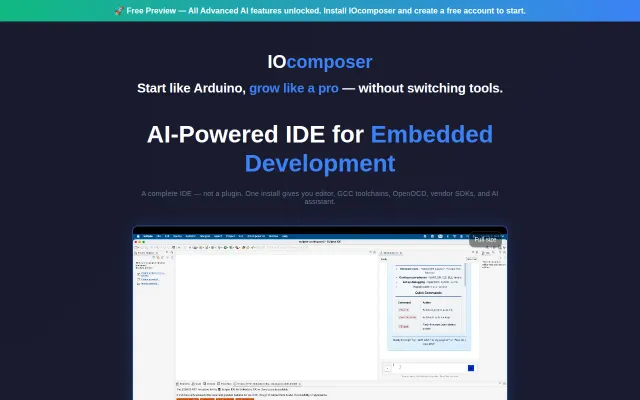
Bare-metal BLE firmware with vendor SDK indexing—no Device Trees, one config per MCU.
Full Rust IDE running in a blue-screen TUI that can actually build itself.
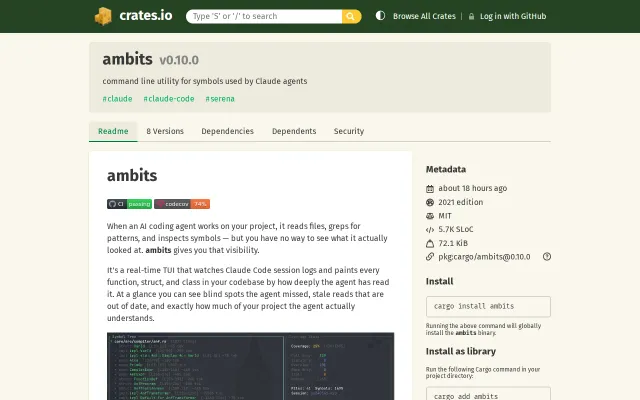
Tails Claude Code's JSONL and paints every function/struct/class by read-depth (unseen → name-only → full body) in a live terminal tree — plus automatic staleness marking when files change. The multi-agent tracking and optional Serena LSP backend are smart touches that make this more than a neat demo: it's practical observability for agent-driven workflows, though it's tightly coupled to Claude/Serena ecosystems.
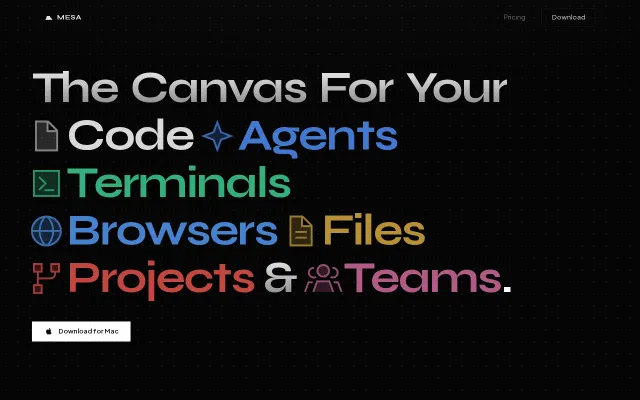
Figma-style canvas for code replaces tab-switching with spatial multi-repo workflows.