Developer Tools●●Solid
Code-Graph-RAG – Knowledge graph RAG for any codebase
Knowledge graph RAG for code when Cursor and Cody already own this space.
Big BrainSolve My Problem
vitali87
113mo ago
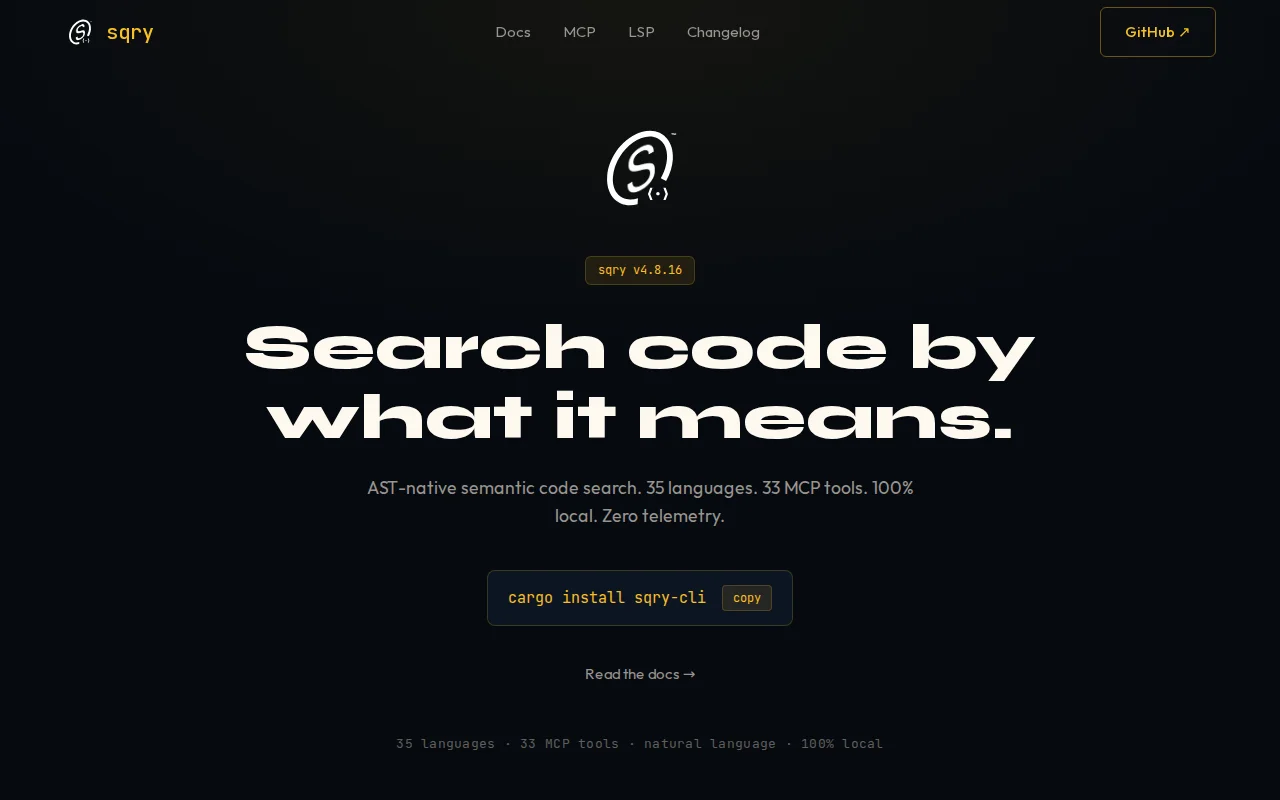
12ms exact call-graph queries beat 1,400ms embeddings; 35 languages, zero cloud required.
Backend/systems engineers, DevSecOps teams, private/regulated codebases, Rust/C++ heavy projects
Sourcegraph · Continue.dev · GitHub Copilot with local indexing
The motivation: ripgrep is great for finding strings, but it can't tell you "who calls this function", "what does this function call", or "find all public async functions that return Result". Those questions require understanding code structure, not just matching patterns.
sqry parses your code into an AST using tree-sitter, builds a unified call/ import/dependency graph, and lets you query it:
sqry query "callers:authenticate" sqry query "kind:function AND visibility:public AND lang:rust" sqry graph trace-path main handle_request sqry cycles sqry ask "find all error handling functions"
The `sqry ask` command translates natural language into sqry query syntax locally, using a compact 22M-parameter model with no network calls.Some things that might be interesting to HN:
- 35 language plugins via tree-sitter (C, Rust, Go, Python, TypeScript, Java, SQL, Terraform, and more) - Cross-language edge detection: FFI linking (Rust↔C/C++), HTTP route matching (JS/TS↔Python/Java/Go) - 33-tool MCP server so AI assistants get exact call graph data instead of relying on embedding similarity - Arena-based graph with CSR storage; indexed queries run ~4ms warm - Cycle detection, dead code analysis, semantic diff between git refs
It's MIT-licensed and builds from source with Rust 1.90+. Fair warning: full build takes ~20 GB disk because 35 tree-sitter grammars compile from source.
Repo: https://github.com/verivusai-labs/sqry Docs: https://sqry.dev
Happy to answer questions about the architecture, the NL translation approach, or the cross-language detection.
Knowledge graph RAG for code when Cursor and Cody already own this space.
Enterprise semantic layer with NL-to-dashboard in a crowded market dominated by Snowflake and Microsoft.
CogDB integration is the differentiator, but text-to-KG is a solved pattern.
Natural language queries with millisecond execution traces offer a unique debugging window.
Persistent memory layer stores decisions across sessions when other tools forget everything.
Natural language API routing—but Langchain integrations and API directories already solve this.