Developer Tools●●Solid
An MCP server for the docs of any repo that uses Sphinx
Faster doc search for AI agents than vanilla Sphinx, with RRF hybrid retrieval.
Niche GemSolve My ProblemShip It
btcalex
303mo ago
Agent-optimized CLI design but competes with Cursor and Continue directly.
AI agent developers, terminal-based workflow users
Cursor · Continue · Sourcegraph Cody
GitHub: https://github.com/nozomio-labs/nia-cli
We originally built Nia as an MCP server and API, but a lot of the most capable agents today, like Claude Code, Cursor, and custom shell-based pipelines, live in the terminal. For those agents, a CLI felt like the most natural interface.
What it can do:
- Index repos, docs, papers, datasets, and local folders - Search across indexed sources with hybrid retrieval - Research codebases or personal data with cited outputs - Persist context so agents can save plans, decisions, and notes, then resume later without losing the thread - Search without indexing across the web, GitHub, and package registries
A few things we designed specifically for agents:
- structured JSON output - async-first workflows - non-interactive commands - composable multi-step pipelines - local folder sync and watch support
A few example commands:
nia repos index vercel/ai nia search query "How does auth middleware work?" nia oracle job "How does TurboPuffer handle vector quantization internally?" nia contexts save "Auth refactor plan" --content "$(cat plan.md)"
Install:
bunx nia-wizard@latest
Open source repo: https://github.com/nozomio-labs/nia-cli
Blog post: https://trynia.ai/blog/introducing-nia-cli
Would love feedback, especially from people building terminal-native agent workflows.
Faster doc search for AI agents than vanilla Sphinx, with RRF hybrid retrieval.
Chat-with-your-codebase tool, but Cursor, Continue, and Cody already own this.
Local doc indexing for Claude Code beats context-switching to browser tabs.
Surfaces architectural decisions from git history — Cursor and Continue don't do this.
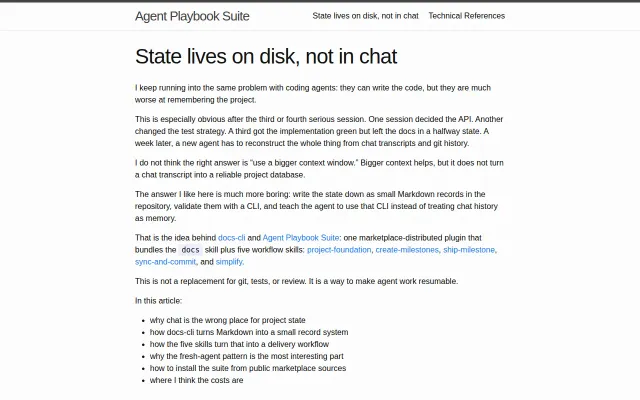
Treats Markdown files as a database so fresh agents don't need to read 70k token chat logs.
Useful MDN index, but MDN's own search and navigation already cover this.