Developer Tools●●Solid
Lockstep – A data-oriented programming language
Compiler-enforced branchless SIMD execution guarantees vector saturation without runtime checks.
Big BrainNiche Gem
goosethe
863mo ago
Zero malloc churn via 4GB mmap arena—clever, but adoption is the real battle.
DevOps engineers, SREs, infrastructure developers
Starlark · Just · Task
I write a lot of infrastructure tooling and got frustrated with the usual trilemma: Bash gets unmaintainable past 50 lines, Python's interpreter startup/bloat feels too heavy for fast pipeline tasks, and Rust/Go can be too verbose for simple OS-level scripting.
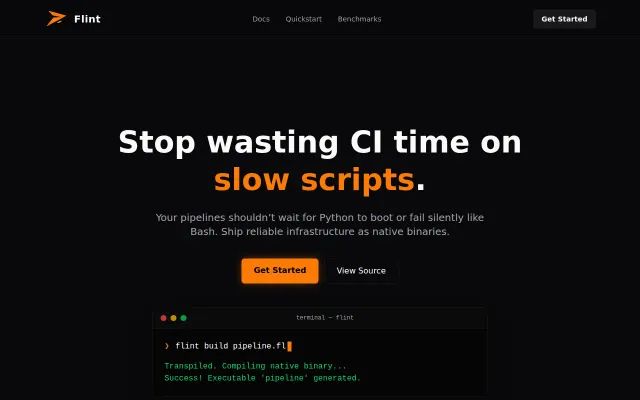
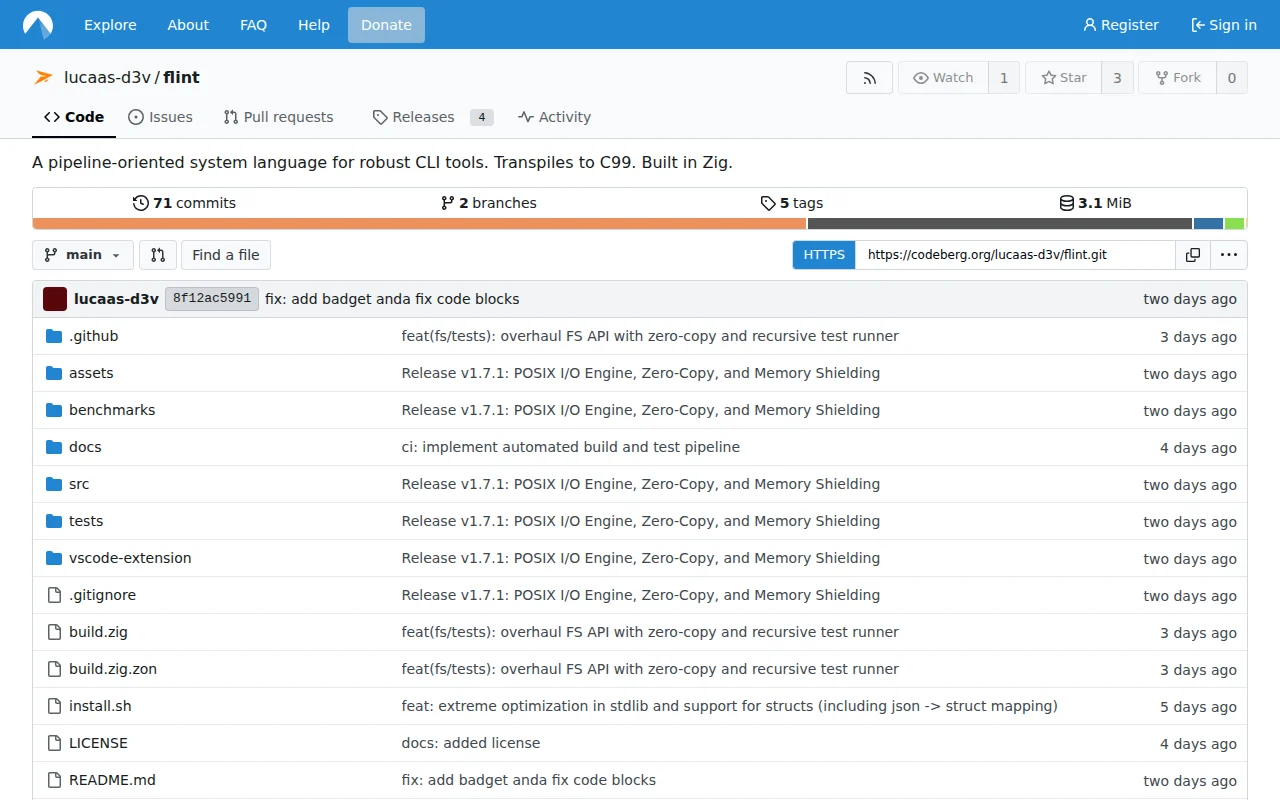
So I built Flint. It’s an experimental, statically-typed language written in Zig that transpiles directly to C99, compiling down to a dependency-free native binary. It is strictly designed for DevOps, SRE, and CLI automation.
Some of the core engineering decisions:
1. The Pipeline Operator (~>): Data flows forward. No nested function hell. It’s functional composition mapped to C. 2. Memory Model: Zero garbage collection and zero `malloc` churn. It uses a 4GB virtual arena via `mmap(MAP_NORESERVE)`. Scripts boot instantly and die cleanly. 3. Zero-Copy Strings: Strings are fat pointers (ptr + len). Operations like `split()` or `lines()` are just memory slicing, which drastically speeds up parsing large logs or JSONs. 4. OS-Level I/O: We bypass User Space bottlenecks where possible. The `copy()` function delegates directly to the `sendfile` syscall. Process orchestration uses `posix_spawnp` instead of expensive `fork()` cloning. 5. Explicit Errors: Inspired by Zig, I/O operations require an explicit `catch |err|` block. No silent Bash failures.
A quick example of what a log parser looks like: ```flint const raw_logs = read_file("server_access.log") catch |err| { exit(1); };
raw_logs ~> to_str() ~> lines() ~> grep("403 FORBIDDEN") ~> join("\n") ~> write_file("threat_report.log") catch |err| { exit(1); };
```
Trade-offs & Current State (v1.7.1): It is NOT a general-purpose language. It lacks a garbage collector by design (long-running daemons will eventually exhaust the arena). I'm currently working on a deep-walk semantic analyzer to enforce proper namespace isolation for the upcoming v1.7.2.
I would love brutal feedback on the architecture, specifically the Zig-to-C99 transpilation pipeline and the arena implementation in the C runtime.
Repo: https://codeberg.org/lucaas-d3v/flint Mirror: https://github.com/lucaas-d3v/flint
Compiler-enforced branchless SIMD execution guarantees vector saturation without runtime checks.
Native binaries for CI scripts beat Python startup time without Rust verbosity.
Built-in reactive runtime and dual JS/WASM targets challenge React and TypeScript dominance.
Endianness in the type system is clever, but another language in a saturated field.
Design-by-contract baked into grammar for a no-GC systems language.
Scripting language with native Go interop, compiles to standalone binaries.