Developer Tools●●●Banger
Tinysandbox – An ultra-minimal sandbox with QuickJS WASM isolates
WASM isolates instead of containers means millisecond recycling and KB-scale idle memory.
WizardryBig Brain
dangoodmanUT
4024d ago
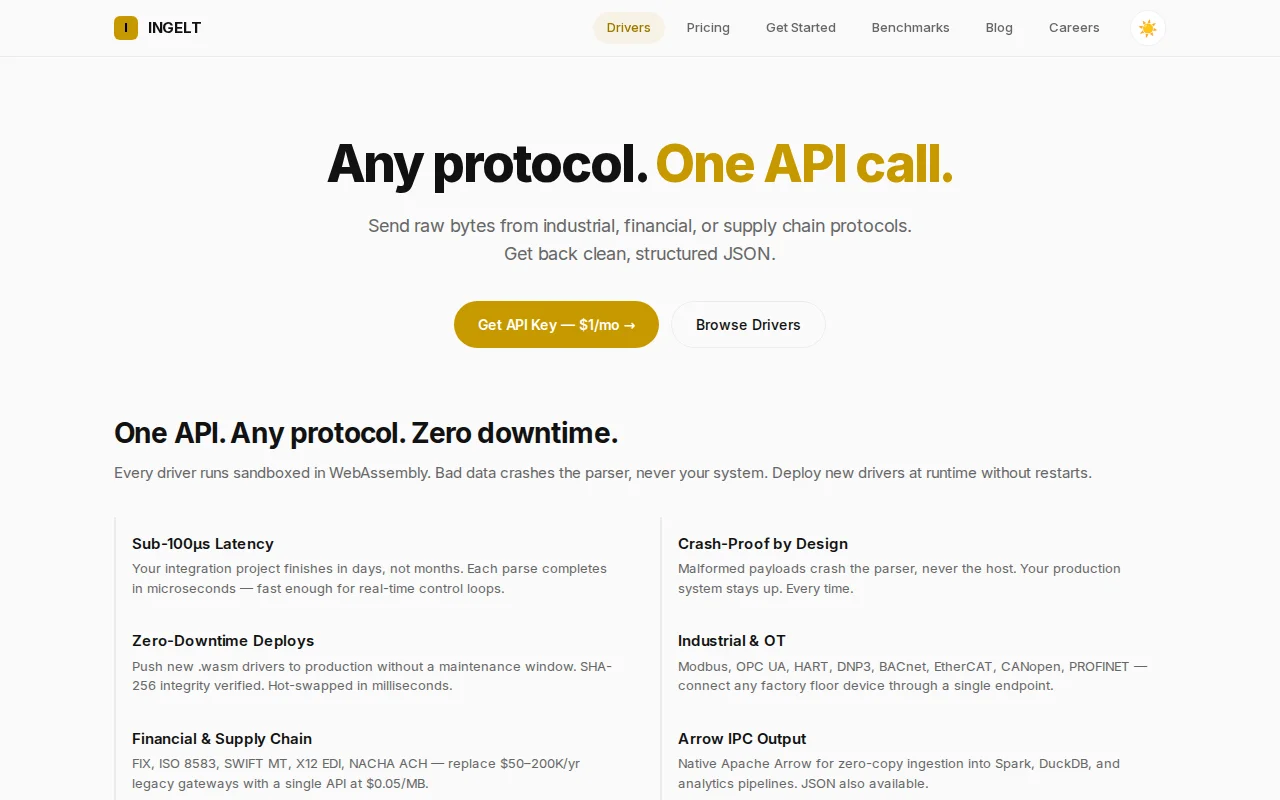
WASM sandboxes per parser replace $200K legacy gateways at $0.05/MB.
Industrial IoT teams, data engineers handling legacy protocol integration
Kepware · Matrikon · Softing
Ingelt is a Rust/Axum gateway that compiles 33 different legacy protocols (Modbus, BACnet, X12, SECS/GEM, etc.) into isolated WebAssembly sandboxes.
I have some background in data engineering and in the past, it was so frustrating seeing data pipelines fail due to some quirk on a single row, special character, badly escaped quote, etc... to bring down an entire pipeline.
I've been thinking about the problem space and how it abstracts nicely to a common API surface. I understand that industrial data pipelines similarly panic because a legacy C/C++ Modbus or EDIFACT parser hit a malformed hex payload and segfaulted. Industrial and supply chain data is basically hostile by default.
The architecture is pretty straightforward:
Strict Isolation: Every parse request gets its own pooled Wasmtime instance. If a parser hits an infinite loop, Wasmtime fuel metering kills it. If a malformed payload tries to allocate too much memory, a 64MB StoreLimitsBuilder ceiling traps it. The host never panics.
Streaming ABI: I recently added a chunked streaming ABI (parse_init -> parse_chunk -> parse_finalize). It can now ingest a 500MB maritime EDIFACT file with a flat ~1MB memory footprint inside the guest.
Output: It spits out clean JSON, or Apache Arrow IPC if you want to pipe it directly into a data warehouse.
It is definitely a trade-off. Crossing the Wasm boundary and doing JSON serialization inside the guest adds a few microseconds of latency compared to a raw native parser, but many parsers are pretty slow. I think the trade-off makes sense.
I'd appreciate any thoughts on the Wasm isolation model, the streaming ABI approach, or if you think there's a better way to handle the host-guest memory bridge. I'm coming at this as an outsider to industrial protocols and the painpoints for using them, and I'm trying to learn quickly.
Thanks
WASM isolates instead of containers means millisecond recycling and KB-scale idle memory.
Guided raster-to-SVG tracing with genetic optimization offers more control than Vectorizer.ai.
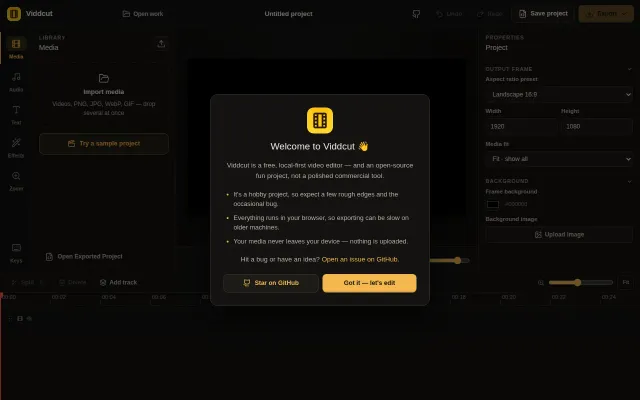
Rust/WASM video editing in browser is impressive, but browser editors already exist.
WASM-powered FFT visualizer, but lacks unique features beyond existing tools.
Implements its own Brotli decompression for WOFF2 to bypass missing browser APIs.
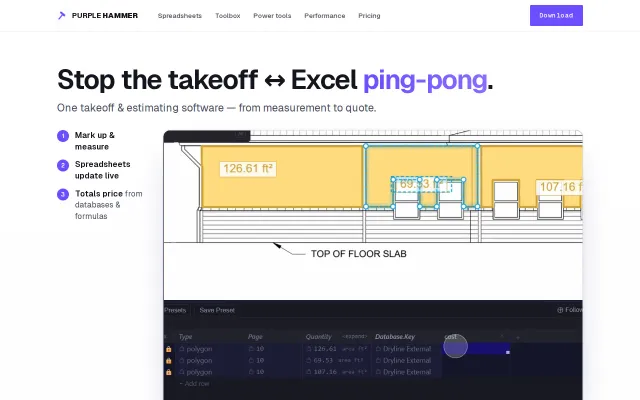
Stops the Bluebeam-Excel ping-pong with live spreadsheets and 120 FPS million-vector rendering.