Developer Tools●●●Banger
UltraContext – open-source shared context layer for coding agents
Real-time context sync across Claude Code, Codex, Cursor—solves actual agent isolation.
Big BrainShip ItSolve My Problem
ofabioroma
112mo ago
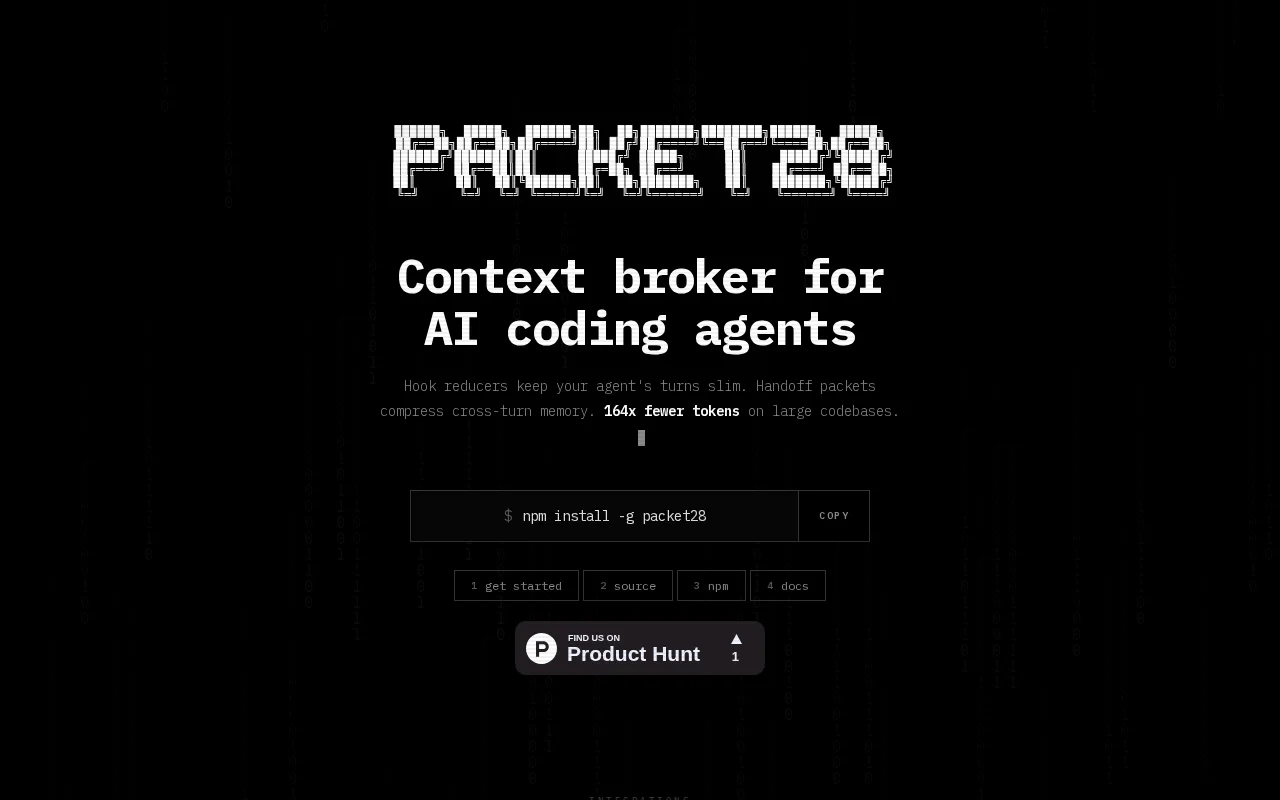
Slash agent token costs 164x with hook reducers and persistent daemon state.
Developers using AI coding agents on large codebases
Mem0 · LangChain · Cursor
Repo reads, diffs, logs, stack traces, and tool output keep getting dragged into the next step. That works for short tasks, but on longer loops the agent starts spending too much of its budget re-reading history.
Packet28 is my attempt at fixing that.
It’s an open-source MCP + hook system that reduces noisy dev/tool output into smaller packets, persists useful state in a daemon, and prepares handoffs when context gets too full. The goal is to keep the live turn small instead of letting one session grow forever.
You can install it locally and run setup on your own repo today. Packet28 currently exposes MCP tools, supports proxying upstream MCP servers, integrates with hooks, and uses packet28d for persistent state, indexing, caching, and handoff/relaunch flows.
Would love feedback on whether this fits real agent workflows, whether the MCP + hooks split makes sense, and what reducers or integrations would make it more useful. I’ll be around in the thread.
Real-time context sync across Claude Code, Codex, Cursor—solves actual agent isolation.
Three-layer orphan process cleanup for Claude Code's known memory leak.
Auto-discovers repeated agent instructions from session history, then PRS them.
AGENTS.md with retrieval discipline — Cursor rules and Continue.dev already provide similar context.
Prevents Claude context collapse via 3-hook rotation pipeline—ambitious but production setup is heavyweight.
Decision memory with enforceable context beats Cursor's built-in context features.