Productivity●Mid

blockd – my attempt at un-noding workflow automation platforms
Zapier alternative with AI when Make and n8n already exist.
Slick
KNQuoc
312mo ago
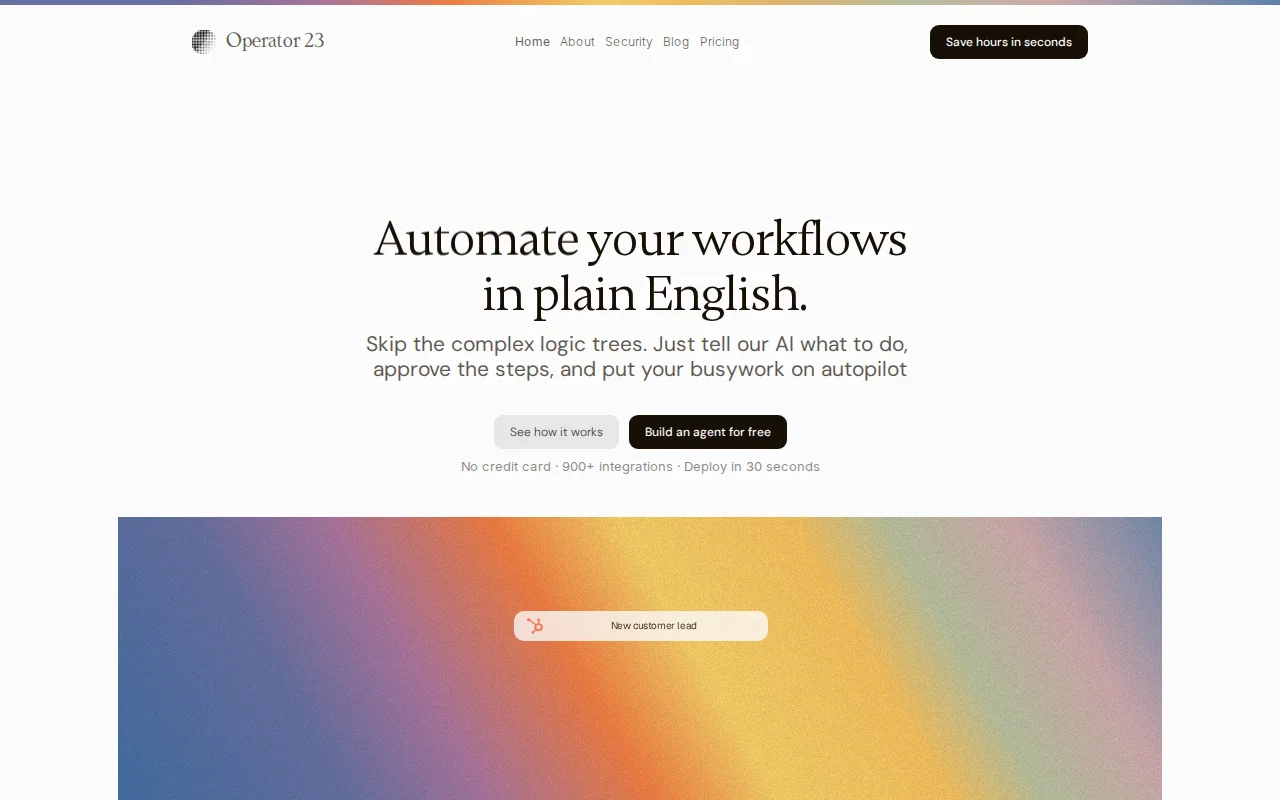
Yet another Zapier alternative where plain English replaces flowchart builders.
Non-technical operations and marketing teams
Zapier · Make · n8n
We talked to marketing ops people recently to validate whether we are solving the right problems. Three things came up every single time.
Setup complexity. People are not afraid of automation in theory. They are afraid of spending two hours configuring conditions and field mappings, only to have something silently misroute. The config layer is where confidence dies.
Debugging. When a workflow breaks there is usually no explanation. A trigger did not fire, data passed null downstream, a sequence stopped. You find out three weeks later when someone downstream asks a question. Nobody knows where it went wrong so they delete it and go back to doing it manually.
No trust without control. Everyone wanted to keep a review step before the system acts on its own. Not forever, but until it had proven itself across enough edge cases. The unlock for automation adoption is not fewer steps, it is making it safe to delegate gradually.
What we are building is a system that addresses all three. Plain English input so setup is fast, step-by-step explanations so debugging is readable, and staged autonomy so trust is earnable.
For founders who have built or managed GTM and marketing ops teams: does this match what you have seen. And is there a fourth problem we are missing.
Zapier alternative with AI when Make and n8n already exist.
Zapier alternative that claims to fix itself, but the AI claims need real proof.
Zapier alternative with AI generation, but Zapier (with AI) and Make already own this space.
DoScript trades shell terseness for English-like primitives (make folder, for_each file_in ...) plus safety features like a global --dry-run, typed errors (try/catch NetworkError) and rich file-loop metadata — handy for ad-hoc backups and file-sorting. The inclusion of a node-based visual IDE and a tiny installer suggests someone pushed this beyond a toy CLI, but the overall idea sits in a crowded space (PowerShell, Node-RED, AutoHotkey) so its appeal will be strongest for users who value human-readable syntax and a simple GUI.
Natural language test generation via Claude; OpenAPI scanner auto-detects specs from source.
Natural-language keywords plus implicit file metadata in loops make common file tasks unexpectedly readable, and the built-in --dry-run and explicit error reporting show a sensible safety-first design. It isn't revolutionary — PowerShell and dozens of RPA/DSL tools exist — but as a compact, distributable exe for teams that loathe terse shell one-liners it’s a practical, usable effort; the main gaps are cross-platform clarity and a larger ecosystem of libraries/examples.