Developer Tools●Mid
dank-py – turn existing Python agents into microservices in 2 commands
Two-command Docker packaging, but FastAPI and Modal already solve agent deployment.
Ship It
deltadarkly
412mo ago
Free open source OSINT platform for gathering, ingesting, and analyzing open-source intelligence data
Functional pipeline with Neo4j graphs, but training system and GPU support aren't built yet.
Researchers and journalists tracking news sources and entity relationships
Feedly · Inoreader · Maltego
It's really simple: docker compose, micro services connected to some very basic data pipelines using rabbitMQ, and some local NLP. The NLP portion is a bit slow as it's pure CPU and doesn't leverage GPU/NPE if you have them.
The tool offers you to define your own "labels" and "relations", which are then picked up by the local NLP models to assign it to news articles. Standard, there are only a few included.
But the goal is to have your own personal news aggregator, and adding/changing news sources (if they have a rss feed) should be pretty easy through the docker compose file.
Two-command Docker packaging, but FastAPI and Modal already solve agent deployment.
Aggregates 60 OSINT feeds into one map with pseudonymous P2P comms built in.
Pulls together passive sources — crt.sh, Wayback, GitHub search, Shodan and Hunter — into a single HTML+JSON output so you can run recon without touching the target. It isn't reinventing OSINT, but the combination of multi-source subdomain enumeration, built-in WHOIS/JSON export and a ready-to-share dark report plus Docker support makes it an immediately useful tool for quick triage.
Complete Kafka pipeline demo with live dashboard, but it's a teaching repo not a product.
Competent budget app with standard architecture; Mint/YNAB alternatives already exist everywhere.
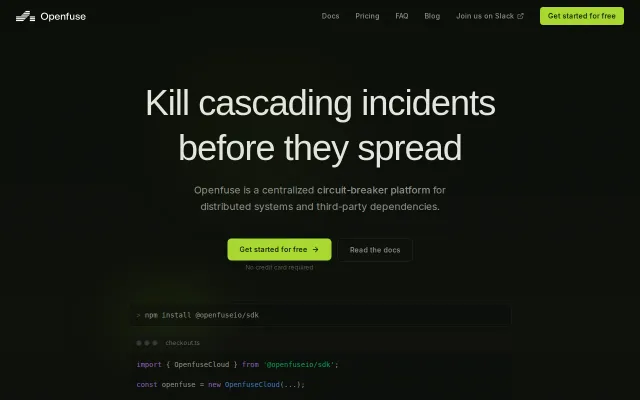
Centralized circuit breakers fix the per-instance state problem Opossum, Resilience4j miss.