Developer Tools●Mid
Parevo Core – Auth, tenant, permission in one Go library
Yet another auth library when Clerk and Casbin already dominate the space.
Ship It
parevo
103mo ago
Auto-throttles noisy Postgres tenants using pg_terminate_backend before Datadog even alerts you.
SaaS operators running multi-tenant PostgreSQL
Datadog never told me the tenant. So I built FaultWall.
Single Go binary, polls pg_stat_statements every 10s, maps queries to tenants via schema detection. Gives you per-tenant QPS, P50/P95/P99 latencies, cost attribution ("acme_corp is 94% of your DB bill"), and an auto-throttler that pg_terminate_backend() before things get bad.
Anomaly detection with self-tuning thresholds (genetic algorithm). MCP server for LLM agent control. I'm building eBPF kernel-level per-query tracing, for better and accurate detection.
DATABASE_URL=postgres://... ./faultwall
If you run multi-tenant Postgres, try it and tell me what's missing.MIT, ~2500 lines Go. https://github.com/shreyasXV/faultwall
Yet another auth library when Clerk and Casbin already dominate the space.
Single binary replaces Postgres, Redis, and ClickHouse stack for web analytics.
Run CI pipelines locally before pushing—Concourse portability without the infrastructure pain.
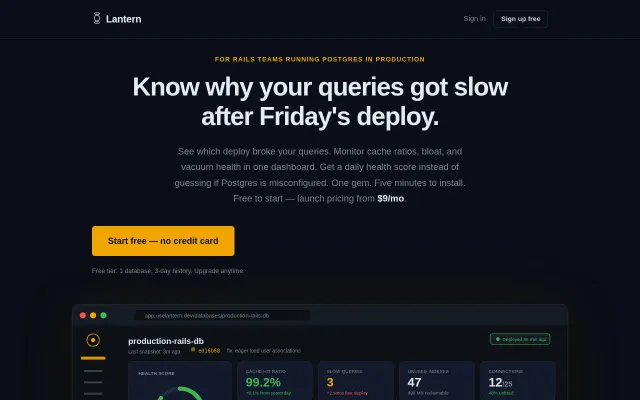
Deploy-correlated query monitoring at $9/mo fills the gap between pgHero and pganalyze.
Structured decision engine with kill signals, but mental models are pattern-matched rules, not learned from actual outcomes.
Temporal's durability guarantees in one Rust binary — no Cassandra cluster required.