Back to browse
I built a Bitcoin signing device where the private key is physical

I built a Bitcoin signing device where the private key is physical

by frozensecurity·Mar 30, 2026·2 points·1 comment

AI Analysis

●●●BangerWizardryBold BetZero to One

Physical titanium key plates eliminate digital key-at-rest vulnerabilities entirely.

Strengths
  • Optical key derivation means the seed never exists digitally on device.
  • Dual-MCU hardware isolation prevents comms-side compromises from reaching signing logic.
Weaknesses
  • Proprietary hardware means you can't audit the signing terminal firmware yourself.
  • Loss of physical plate means total fund loss with no digital backup.
Category
Target Audience

Bitcoin holders and security enthusiasts

Similar To

Ledger · Trezor · Coldcard

Post Description

The core problem I kept running into with hardware wallets: the private key exists as a persistent digital object inside a chip. It’s protected — but it exists. That’s the vulnerability. Protection fails; existence is structural. I built a different model. The private key is encoded as a geometric hole pattern in a titanium plate. A signing terminal reads the plate optically, derives the key transiently in volatile memory, signs the transaction, and discards everything. The plate doesn’t change. Nothing is stored. A few implementation details that might interest people here: The signing terminal uses two physically isolated MCUs — one handles communications, one handles signing. They are not software-separated. The communications MCU is physically disconnected during key derivation. This isn’t air-gapped in the usual sense; the isolation is enforced at the hardware layer, not the software layer. The key derivation follows BIP-39/BIP-32. The plate encodes the seed phrase as a geometric representation. The terminal reads the geometry, derives the entropy, derives the key, signs, clears volatile memory. The plate never changes state and has no electronic components. The threat model this addresses: persistent digital key at rest. Hardware wallet attacks — glitching, side-channel, physical decapping — all require the key to exist somewhere in the device. If it doesn’t exist, those attack surfaces don’t exist. The attack window is constrained to a single observable physical interaction, not an indefinite future. Patent application published: US 2026/0039478. Pre-orders open at frozensecurity.com. Happy to go deep on the architecture, the encoding scheme, or the threat model.

Similar Projects

Security●●●Banger

Vestauth – Auth for Agents

Agent auth via key-signing beats API keys and OAuth for autonomous systems.

Big BrainSolve My ProblemZero to One
scottmotte
1113mo ago
Security●●Solid

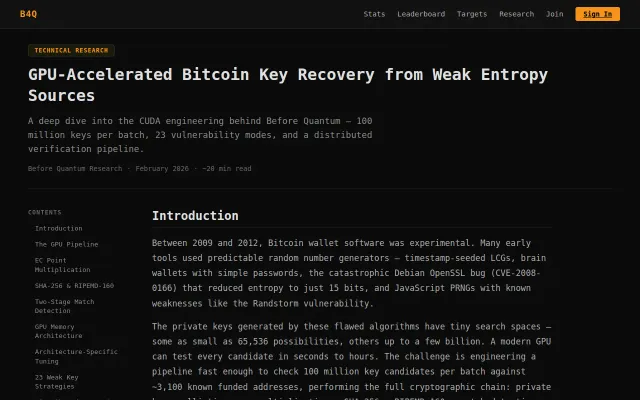
GPU-accelerated search for Bitcoin keys generated with weak entropy

This reads like a GPU engineer's field notes — one ~3,400-line CUDA file implements a full per-thread crypto pipeline (key gen → EC multiply → SHA-256 → RIPEMD-160) and a two-stage bloom+binary-search matcher to check ~3,100 targets at ~100M keys per batch. The article digs into concrete low-level choices (LUT layout, memory hierarchy, __ldg reads, atomicCAS reporting, and per-mode keygen strategies), which is rare in public writeups; downside is it's closed-source and the dual-use/ethical implications should be called out more explicitly.

WizardryNiche Gem
orkblutt
213mo ago