Open Source●●●Banger
Aurea, a lossy image codec I built from scratch that beats JPEG (Rust)
Beats JPEG with zero-bit saliency fields and full 4:4:4 chroma — rare codec craft in Rust.
WizardryBig BrainDark Horse
Symphoenix
402mo ago
Sinter — An experimental, fully vibecoded video codec built on lapped transforms and perceptual vector quantization. No deblocking filters, no legacy architecture. Achieves luma quality within 1 dB of H.264 on a fundamentally different design.
Patent-free codec architecture, honestly benchmarks 18.6x worse than H.264.
Video engineers, codec researchers, developers experimenting with AI agents
AV1 · VP9 · x264
And as always, my first shot was how hard could it be to try and build a codec which could be that efficient.
I've personally been on a drive to improve my ability to one-shot complex features, products, or make even surgical changes. It's been a few months since I've been doing that, and honestly, results have been great for both work and work/life balance.
This was a fun experiment. It burned through tokens, but it helped me identify some more improvements I could make to my one-shot agent teams/swarms, notably in the area of brevity and creating a testing rubric when dealing with domains I don't have prior knowledge in.
Ultimately, I did not achieve the compression that I hoped I would, but it was fun seeing the swarm discuss it amongst themselves.
Beats JPEG with zero-bit saliency fields and full 4:4:4 chroma — rare codec craft in Rust.
Per-block codec polymorphism is clever, but format is unstable and zip/7z/tar dominate production.
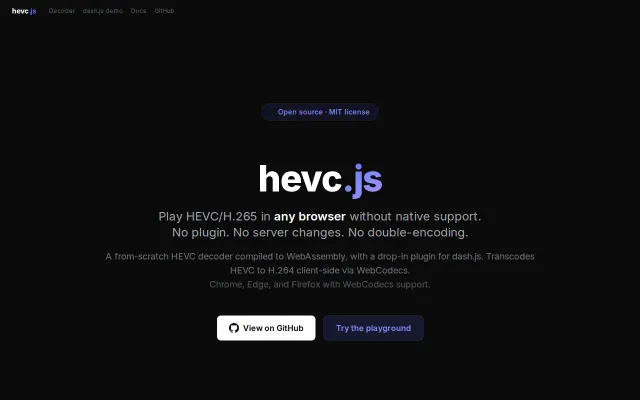
236KB WASM decoder transcodes HEVC to H.264 in-browser, no server changes needed.
Golden ratio codec beats JPEG on NIQE at low bitrate, but no adoption path versus AVIF.
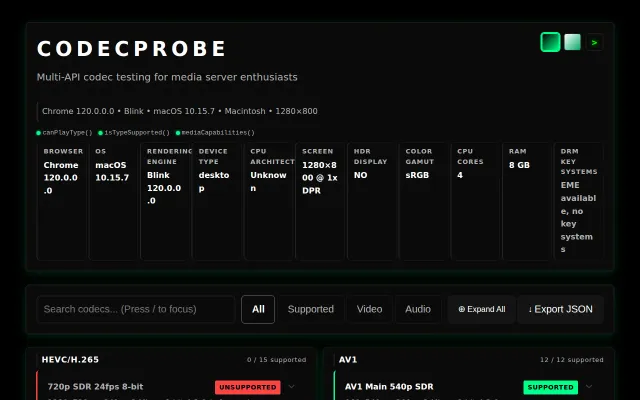
Multi-API codec matrix for media servers—narrow but real pain point for this audience.
Golden ratio color math beats JPEG by 5.9% while keeping full 4:4:4 chroma.