Security●●Solid
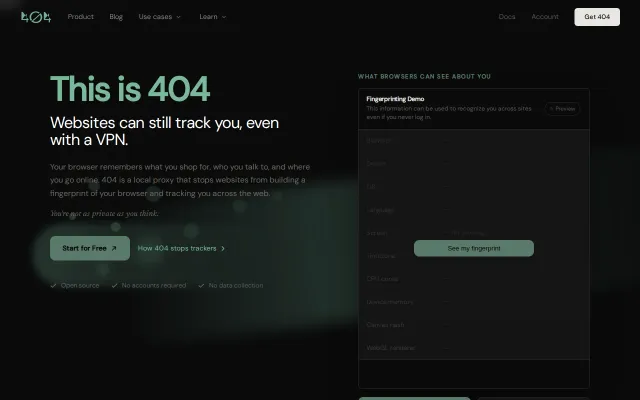
404 – a localhost proxy that substitutes your device fingerprint
Local proxy rewrites fingerprint signals when Privacy Badger and uBlock already exist.
Solve My ProblemDark Horse
un-nf
442mo ago
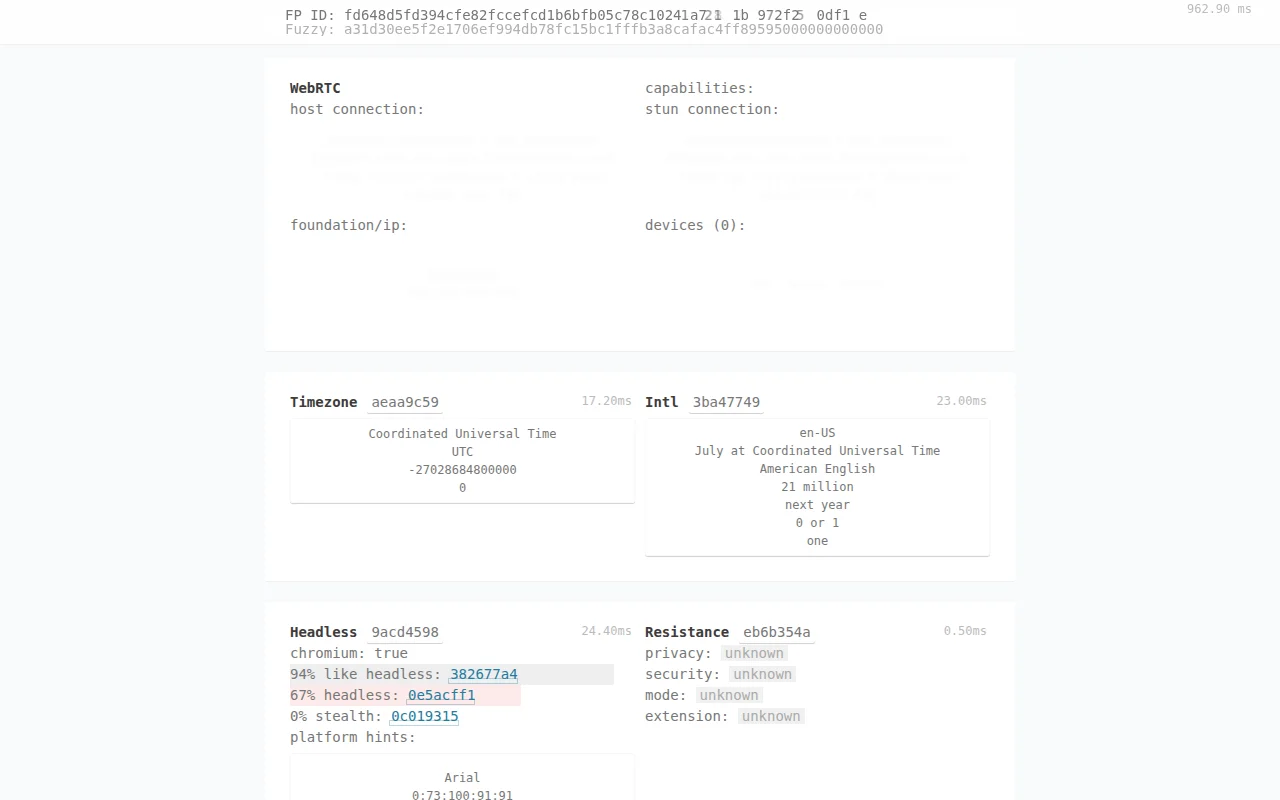
Comprehensive fingerprinting demo, but FingerprintJS already does this in production.
Security researchers, privacy engineers, anti-fraud developers
FingerprintJS · Panopticlick · BrowserLeaks
Anyone knows how fingerprinting works mathematically? what do they use? when the signals may vary even slightly, your final hash should be sufficiently accurate and stable. A simple hash won't do it.
Changing IP, missing cookies/session, resizing window, TLS/SSL browser handshake, screen depth, font rendering, MTR, network latency if you want to measure, etc... any signal alone means little but as a whole mathematically what is it possible to use to get a pretty good stable hash? something I want to learn more about. I guess it has something to do with vectors and clustering signals but no idea and would like to know what exists mathematically to archive this (if possible or with very small error).
And then I want a browser that lets me opt-out all WebAPIs ever possible.
Local proxy rewrites fingerprint signals when Privacy Badger and uBlock already exist.
WebRTC P2P file drop with no backend; but privacy UX is crowded (SnapDrop, OnionShare).
AI-generated font library competing with Google Fonts and DaFont.
tRPC but encrypted by default and transport-agnostic.
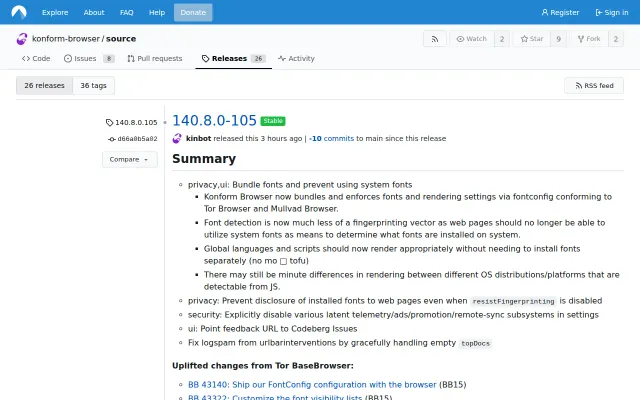
Tor Browser's fingerprinting fixes ported to a usable Firefox fork.
Useful curation, but these datasets already exist on Kaggle and UCI.