Developer Tools●●Solid
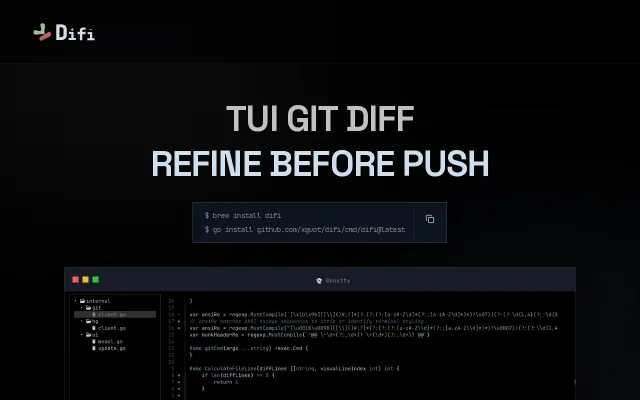
LazyViewer – TUI code viewer with Git diff previews
LazyGit-style TUI for browsing diffs inline with keyboard-friendly tree nav, no mode switching.
Niche GemShip It
xiphias2
303mo ago
AST-aware diff analysis cuts through AI noise better than standard LLM summaries.
Developers using AI coding agents, Tech leads reviewing AI PRs
CodeRabbit · GitHub Copilot Enterprise · Reviewable
I was thinking about building something that would guide me during development and during PR reviews. Something that would give me signals based on facts, risks, and evidence. Not just one LLM reviewing the code it generated. The initial idea was to add a deterministic review layer and combine that with LLM reasoning, and use that to find gaps in code and point me to the most important places, so I don't need to read line by line.
I ended up building a tool called vdiff, and it is working very well for me, and I'm constantly improving it. It is a CLI that analyzes your git diffs and gives you a structured report: what changed, what's risky, and what's missing. It uses tree-sitter for AST diffs and an LLM on top, so you get actual evidence for each finding, not just vibes.
Some of the output signals: - Tells you if it's safe to merge, with a risk score - Lists what's wrong, how confident it is, and shows the evidence - Dependency graph for blast radius analysis - Review memory (tracks resolved/reopened findings across sessions) - You can point it at a spec or PRD, and it checks if the changes actually match - Structural metrics (acyclicity, depth, equality, graph)
It runs locally; I didn't want the tool publishing the code to a third-party server, so your code never leaves your machine. BYOK (bring your own LLM key) - you interact directly with the provider.
If you want to give it a try:
npm i -g @4bk/vdiff # install globally pip install graphifyy # required to generate the knowledge graph cd your-project # go to a git repo vdiff init # set up provider, API key, build knowledge graph vdiff -v # analyze staged changes
Would love to hear if this is something helpful for you as well, and what kind of signals you'd want to see. I usually run it before each commit on a feature branch, and then on CI to verify the feature branch against main.Any feedback is very welcome, and if it is crap, well, then just say it.
Cheers
LazyGit-style TUI for browsing diffs inline with keyboard-friendly tree nav, no mode switching.
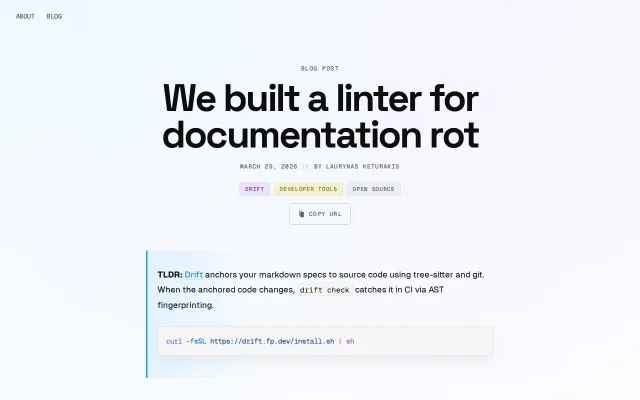
Blocks commits with undocumented code, but doc rot is solved elsewhere (Cursor, GitHub Copilot, type stubs).
AST-level symbol anchoring beats text-matching for catching stale docs in CI.
Neovim-powered diff viewer that works standalone, no plugin manager or config required.
Zsh wrapper around existing LLM APIs; Claude Code and Copilot already do diff review.