Developer Tools●●Solid
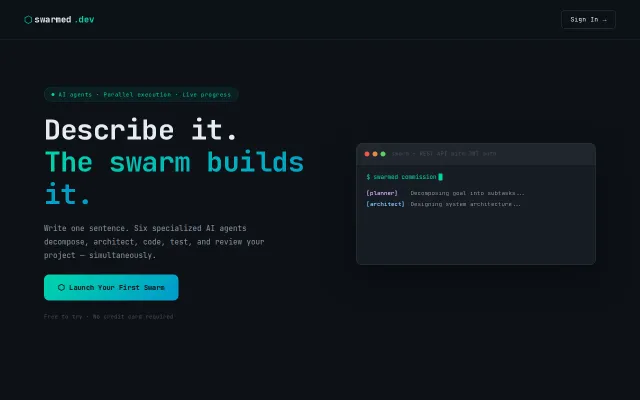
Swarmed.DEV – The Autonomous AI Development Swarm
Six parallel AI agents build full-stack apps, aiming for an agent-forged registry.
Bold BetShip It
freezabb
101mo ago
Worktree isolated dev stacks for parallel coding agents.
203-byte custom URL encoding beats localStorage bracket predictors.
Sports fans wanting to simulate and share World Cup predictions
Bracket Predictor · Football Pool · Championat
I originally built around 5k lines of bash scripts to solve this problem for a single relatively complex application was able to do it, but I realized that for any future thing I might work on I would have to build that whole setup again even though it’s not really that coupled to the specific application I’m working on. I realized I could build a clean, re-usable abstraction to solve this problem robustly and comprehensively for practically any repo through a standard lich.yaml definition and a simple CLI that manages the stack lifecycle, port allocation, log management, and garbage collection. That is what lich is.
You might wonder: why can’t I use docker compose to solve this problem? (or insert other existing tools here). The simple answer is you totally can, but it has two issues: 1. These tools really weren’t built for this use case, they might be able to support it but you’ll end up building a lot of custom tooling to make it possible. Though some tools make it easier than others. 2. If you find a tool that happens to be pretty good at solving this problem, you typically end up needing to adopt its conventions and opinions for your entire stack. Simply put, I don’t want to dockerize all of my services just to be able to run multiple copies of my stack in parallel.
Lich is intentionally designed to be un-opinionated. It sits on top of and drives whatever tooling you already have.
If you have a simple app (just a nextjs app with a development workflow that uses only a hosted testing db for example), you might find that you don’t need lich. That’s probably right. Lich is most useful when you have a relatively complex repo with multiple different services and you also want to run a copy of the DB locally. If you’re thinking about dynamically allocating ports in your startup scripts or managing state and logs, you probably need lich.
I use lich daily to run 3-5 independent stacks in parallel from different worktrees for a complex application with 5+ services and multiple docker containers per stack.
I’ve released Lich as open source with the MIT license. There’s a demo video in the GitHub readme showing me using Lich to start a dev stack in the main workspace of the lich t3 starter repo and then spawn 5 parallel subagents through Claude Code that each make an edit to the template homepage and then spawn a separate copy of the stack with it’s own DB in parallel.
The easiest way to try out lich is to use that t3 starter repo. You’ll find instructions in the GitHub readme: https://github.com/RPate97/lich
Six parallel AI agents build full-stack apps, aiming for an agent-forged registry.
Git worktree isolation per agent session solves the messy multi-repo problem Cursor ignores.
Catches cross-branch conflicts that CI misses when AI agents work in parallel.
Orchestrates git and gh for stacked PRs, built specifically for AI agent workflows.
Centralized beads queue eliminates per-project init for 50+ parallel Claude sessions.
Turns subjective docs quality into objective pass/fail metrics using dumb agent harnesses.