Security●●Solid
Fakekey – never expose real API keys in the agent environment
MITM proxy swaps fake keys for real ones so agents never see credentials.
Niche GemBig Brain
tomsun28
202mo ago
Just-in-time API keys for AI agents - and any other process you route through it: the caller only ever sees a placeholder.
Agents can't leak secrets they never had—placeholder injection at the wire.
Developers running AI coding agents with API access
HashiCorp Vault Agent · AWS Secrets Manager Proxy
Shai-hulud, prompt-injection - you name it. They cannot steal what your agent (or an process) don't have.
I run coding agents (Claude Code, Codex) on my own machines most of the day. Every one of them wants real API keys in env and I was scratching my head for the last few months how to contain it.
The usual answer to this is a firewall. I don't buy it. A firewall tries to contain a secret the process is still holding, and the rules are painful to maintain.
AVP gives the agent a placeholder and injects the real value at the last moment, on the wire: ``` # the agent's env holds only a placeholder STRIPE_API_KEY=avp-placeholder # agent sends: Authorization: Bearer avp-placeholder # AVP forwards upstream: Authorization: Bearer sk_live_...real... ```
Keep your passwords in your vault where they belong. AVP initially relies on Bitwarden as a secret manager. It's MIT licensed.
Appreciate any feedback.
MITM proxy swaps fake keys for real ones so agents never see credentials.
Agents never see credentials — brokered access beats retrieval for prompt injection safety.
Proxy tokens worthless if leaked, real keys never enter LLM context windows.
It replaces real API keys with short proxy tokens (e.g. PROXY:openai) and uses an X-Upstream-Host allowlist to ensure containers can only hit approved endpoints — neat and low-friction. Comes as a tiny Rust CLI with init/secret set/start commands and clear SDK examples, so you can bolt it onto OpenClaw or Docker agents without adopting a full secrets vault.
The plugin-proxy split is smart: credentials live in a backend (Keychain/1Password/Vault/etc.) and a separate proxy injects auth headers over a UDS so the agent process never handles raw keys. It autosurveys plugin configs and channels to migrate plaintext secrets and even ships a Docker image and CLI for local setups — very practical for anyone already on OpenClaw, though it’s narrowly focused and adds an extra trusted component that deserves an audit.
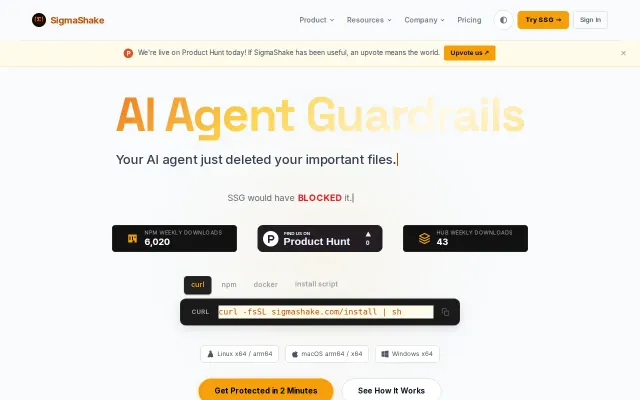
Blocks dangerous AI agent commands like rm -rf before execution in under 2ms.