Infrastructure●●Solid
Impatience – measure event latency on peers using synchronised clocks
Rust port of TimeSync enabling precise event latency measurement without standard library dependencies.
WizardryNiche Gem
foax
1029d ago
ze - a z-fork with event-clock-based exponential moving sum scoring
Event-clock scoring fixes z.sh's decay problem after vacation or inactivity periods.
Terminal power users and shell customizers
zoxide · z.sh · autojump
The underlying issue is that wall-clock time during shell inactivity carries no information about directory relevance. ze.sh replaces wall-clock time with an event clock that advances one tick per cd action. Scores decay only while navigation is occurring. Inactive periods leave scores unchanged.
ze.sh also replaces the traditional frecency heuristic ([visit count] * recency) with an exponential moving sum over the event series (mathematically closely related to the exponential smoothing used for Unix load averages). This avoids a separate ranking artifact where a long-dormant directory with a large historical visit count jumps to the top on first revisit.
The implementation is a single shell file, compatible with bash, zsh, ksh93, and mksh. The database format extends z.sh's format with one additional field, the timestamp field is repurposed to hold the event clock counter.
A related project of mine, SD, also uses the event clock and exponential moving sum paradigms but stores the full event history rather than aggregate state. ze.sh explores how far the same ideas can be pushed while remaining close to the original z.sh design.
I would be interested in hearing whether others have run into the "inactivity-cliff" behaviour, and whether there are solutions to the problem that I have not considered.
Rust port of TimeSync enabling precise event latency measurement without standard library dependencies.
Asserts SLOs against Prometheus metrics instead of flaky wall-clock timing in CI.
Fixed the buggy original firmware—memory leaks gone, tests added, browser flasher works.
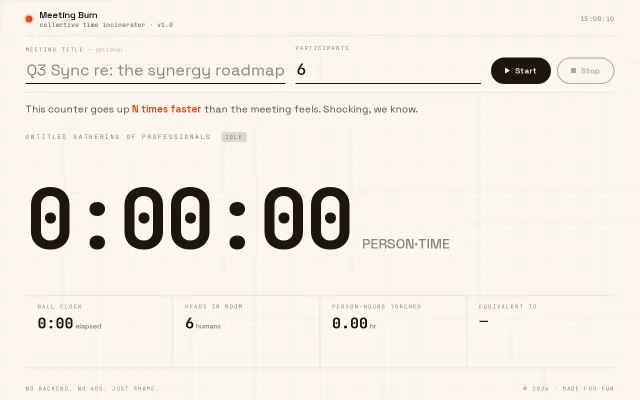
No backend, no ads, just pure shame calculated in real-time.
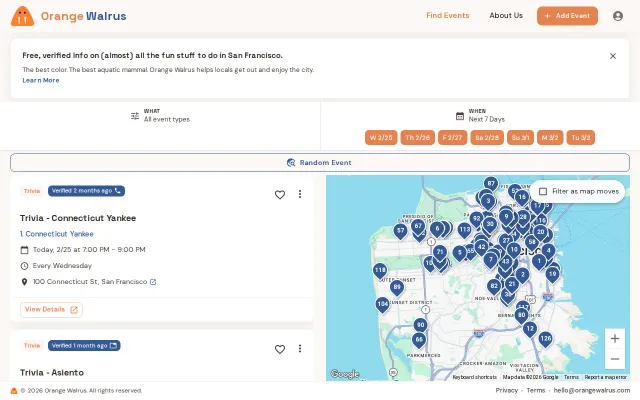
Local event aggregator for SF when Eventbrite, Meetup, Ticketmaster already exist.
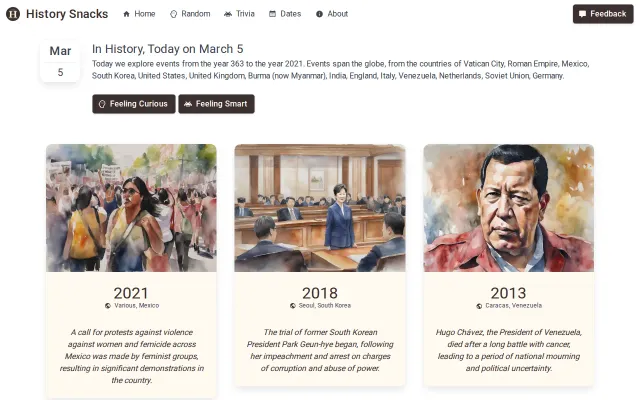
9k curated historical events, but Wikipedia + timeline tools already do this better.