Developer Tools●●Solid
Hive Memory – Cross-project memory for AI coding agents (MCP server)
Cross-project memory for coding agents, but MCP ecosystem is nascent and fragmentation risk high.
Ship ItSolve My Problem
moonx010
103mo ago
🧠 Local-first CLI that gives your repo durable, AI-ready memory — features, ADRs, modules, architecture, standards & tests — and a 🩺 deterministic doctor that validates health, evidence & drift. Git tracks what changed; Persist OS tracks why.
Git tracks what changed; this tracks why — with a CI-gateable doctor command.
Developers using AI coding assistants who want durable project memory
supermemory · mem0 · ADR tools
That’s why I built persist-os. It’s a CLI that runs locally. No network required. It records the architecture decisions and standards in plain files in the repo and 'persist doctor' checks them - it flags if anything contradicts or is missing, or if the task is done with no tests. Because the rules live in your repo files, it doesn't matter if you start a new session or the session is compacted - the standards and rules survive.
MIT licensed. Here’s how you can try it: npx persist-os@latest init
Cross-project memory for coding agents, but MCP ecosystem is nascent and fragmentation risk high.
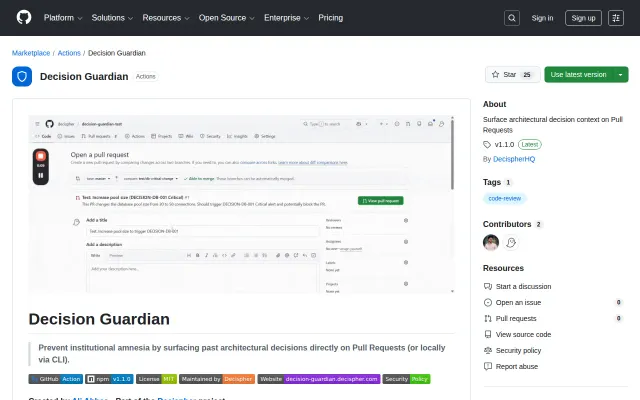
Content-aware rule matching on diffs surfaces only relevant decisions, not noise.
Markdown-driven decision surfacing with Trie-based matching outperforms Slack threads.
Decision logs and task graphs bring engineering process to chaotic AI coding sessions.
Trigger-based cognitive architecture for Claude Code loses context anyway without API-level state persistence.
Auto-comments architectural context on PRs via GitHub Actions; solves real institutional knowledge loss.