Social●Mid
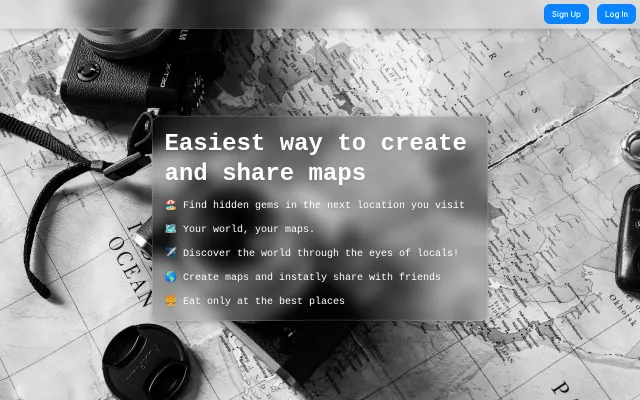
Map Joy, easiest way to create and share maps
Google Maps is clunky, but this landing page offers zero proof of a better map engine.
Ship It
coolThingsFirst
101mo ago
Memory map numpy arrays on S3
userfaultfd for S3 lazy-loading—400MB DataFrames in 100ms without full downloads.
Data engineers working with large S3 datasets in Polars or numpy
sql.js-httpvfs · smart_open · s3fs
This allows you to "download" a multi-gigabyte file on S3 into a Polars DataFrame in <100ms.
# Demo
alloc = demandmap.S3Alloc( "./cache.bin", # number of blocks capacity=512, # one megabyte block (per request chunk size) block_size=1048576 )
buf1 = alloc.get(S3_PATH) # Big file assert buf1.nbytes > 400000000 # But this takes ~100ms df = pl.DataFrame([buf1])
It's one of those problems that manages to be both simple and difficult. I'd wager <5% of devs know what a memory map is (higher on HN) and I'd wager 1% of devs who know what mmap is know you can catch page faults in user-space, and yet another 1% of those devs know that it's possible to do userfaultfd in macOS with truly obscure mach_send_msg calls.I'd really like to build a cross platform user faulting library covering Linux and Windows too, because nearly everyone who's touched a dataframe has had this exact problem.
Google Maps is clunky, but this landing page offers zero proof of a better map engine.
It actually parses vector tiles and renders a searchable, pannable ASCII map — not just an image dump. Useful touches like street-name toggles, aspect-ratio adjustment, and a single-homebrew install make it feel like a lovingly crafted hacker tool; still mostly a novelty, but technically neat and fun to poke at.
Canva for Maps when Mapbox, Google My Maps, and Carto already dominate this space.
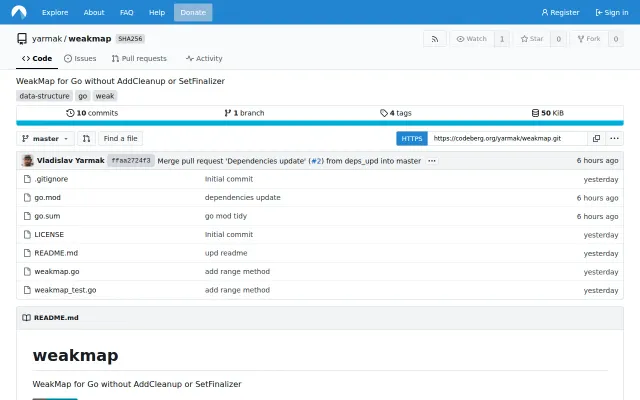
Tiny Go library avoiding finalizers, but the standard library already covers this.
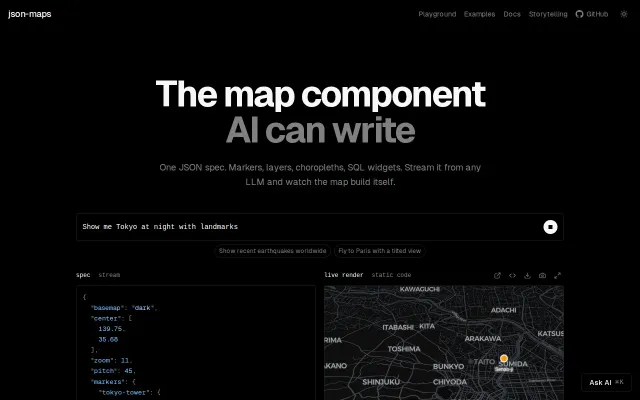
MapLibre spec layer with DuckDB widgets, but Mapbox GL JS + alternatives already solve this.
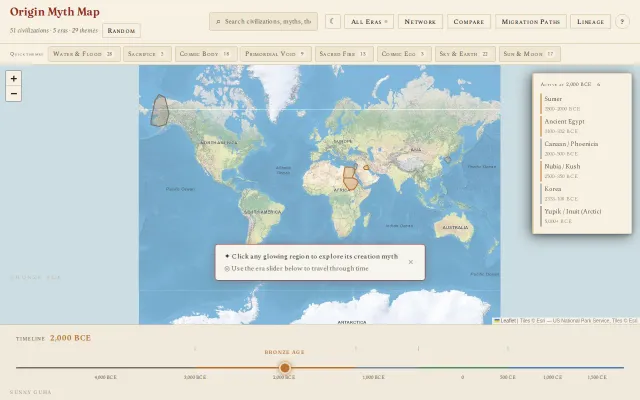
Timeline slider lets you traverse 5,000 years of creation myths across 51 civilizations.