Productivity●Mid
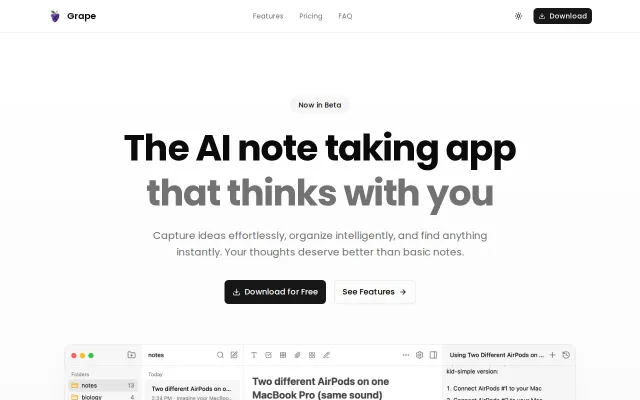
Grape – AI note taking app
Yet another AI notes app competing with Notion, Obsidian, and Mem without clear differentiation.
Slick
ozgrozer
423mo ago
An AI-powered research assistant that helps researchers, students, and curious minds find, understand, and organize scientific literature faster.
Full-stack learning project that actually solves a real problem for researchers.
Researchers, students, academics seeking alternatives to Google Scholar and Consensus
Consensus · Google Scholar · SciSpace
Started with a single Next.js app, switched to Monorepo due to growing complexity. Has analytics, email, payment, ai, backend, frontend, help & docs - everything most modern apps need. Even some barebones for a mobile app and a browser extension (using wxt).
The main features are a search engine powered by Semantic Scholar, AI summaries, folders - with rich text notes (using WYSIWYG) & sharing.
Thinking of adding different AI models and a BYOK feature.
Here's a quick demo video too - https://drive.google.com/file/d/1yv75PEghFN0-53M_Gb4EMefX-sQ...
Yet another AI notes app competing with Notion, Obsidian, and Mem without clear differentiation.
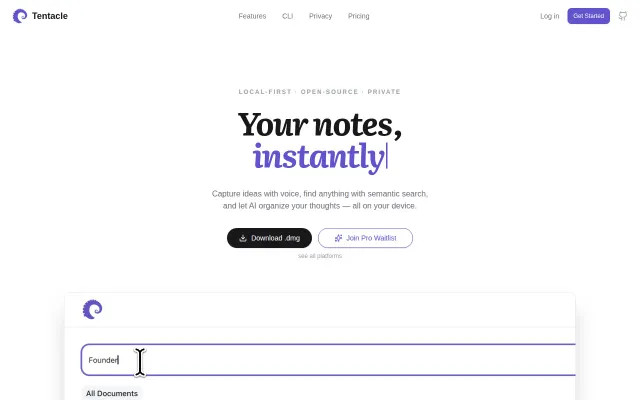
Local embeddings + voice capture + semantic search without vendor lock, ships working today.
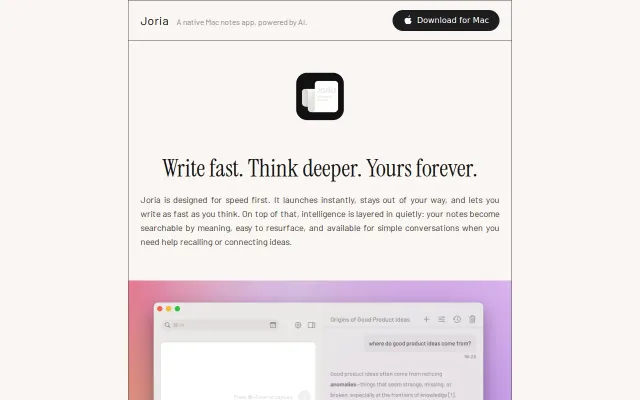
Instant-launch capture bound to a keystroke and local-first storage are the app's best ideas — you can jot something down without breaking flow and then query your notes by meaning. The 'chat with your notes' and use-your-own-AI angle is sensible for privacy-minded users, but the pitch leaves open how sync, model routing, or integrations actually work, and the space already has stiff competition.
Rust-built terminal Zettelkasten with optional LLM that actually works offline.
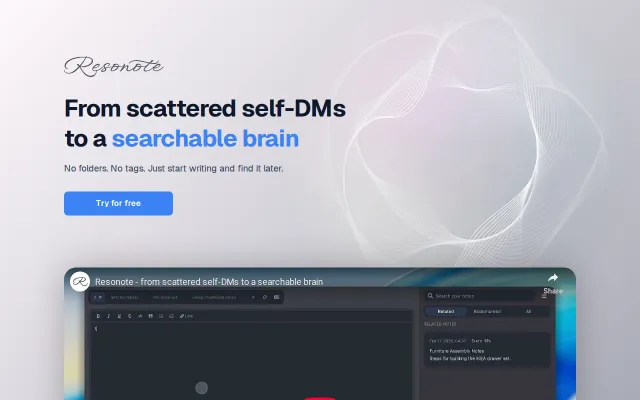
Unnamed drafts and automatic resurfacing are the two gutsy choices here — start writing and the app tries to pull up related notes for you. It's a neat UX shortcut if the semantic matching is strong, but the landing page hides how recall is implemented (model, privacy, offline), and in a crowded space with Mem/Reflect clones that detail matters.
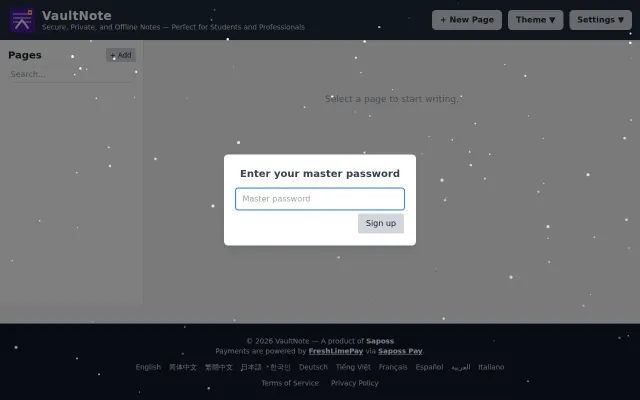
Local-first AES encryption notes, but crowded space with Obsidian, Notion, Logseq alternatives.