Developer Tools●●Solid
MCP Gateway – Zero-Trust Access to MCP Tool Servers
Zero-trust MCP sharing over OpenZiti with no listening ports or VPN setup required.
Big BrainSolve My Problem
michaelquigley
422mo ago
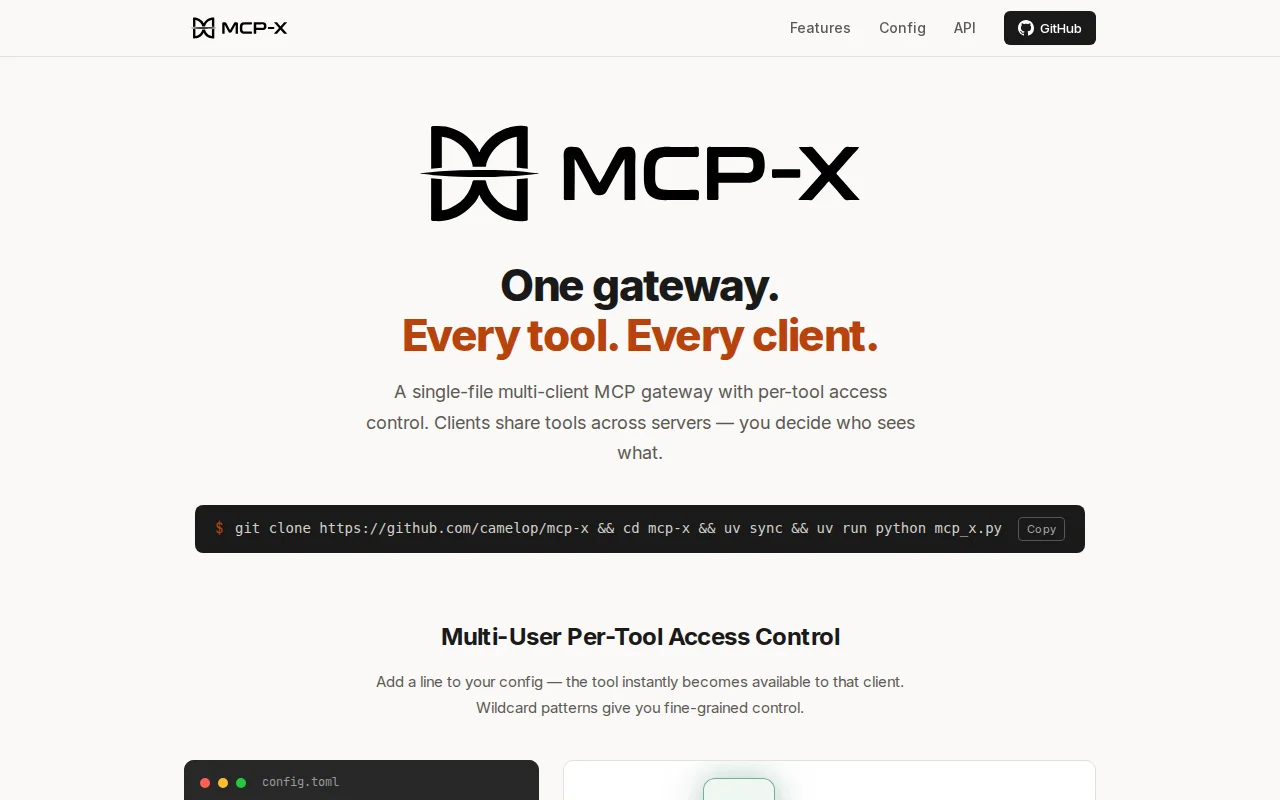
Single-file + live-reload is the practical win here: point your agents at one static URL and you can swap or share upstream MCP servers on the fly via TOML edits or the REST API. The per-tool fnmatch allow-lists, owner registration, and JWT/static token options show the author thought about multi-tenant workflows, but this is a focused infra tool — great when you actually run many MCP servers, less interesting otherwise.
AI/ML engineers, platform/backend developers and ops teams who manage multiple agent tool servers
It works like a file-based proxy - point your agent at the static gateway URL once, then dynamically connect and swap out actual MCP servers behind it at any time via changing config file / REST API. No need to reconfigure your agents when your tools change.
GitHub: https://github.com/camelop/mcp-x
Zero-trust MCP sharing over OpenZiti with no listening ports or VPN setup required.
Finally, shared memory across Claude Desktop and Cursor without cloud accounts.
Symlinks shared MCP servers so you don't reconfigure plugins when switching Claude Code accounts.
Secret redaction and MCP tool integration for Cursor and similar AI clients.
Remote MCP file bridge with sessions and artifact capture, but niche until MCP adoption broadens.
PolyMCP turns Python functions into a single Pyodide WASM bundle so agents can call tools directly in the browser or at the edge — neat and practical. It keeps MCP niceties like input validation, error handling, and orchestration inside the bundle and ships runnable demo HTML to prove the flow. Be realistic about Pyodide trade-offs: bundle size and no native-extension support make this best for lightweight, interactive tools and demos rather than heavy backend workloads.