Productivity●Mid
Local note engine uses LLM to organize notes into a knowledge graph
Hierarchy emerges by subdivision, but Obsidian plugins already auto-tag and link notes.
Ship ItSolve My Problem
AlexWasHeree
11419d ago
Obsidian/Notion alternative: skip hierarchies, just mark lines as data and query later.
Knowledge workers, researchers, students who struggle with upfront note organization
Obsidian · Roam Research · Logseq
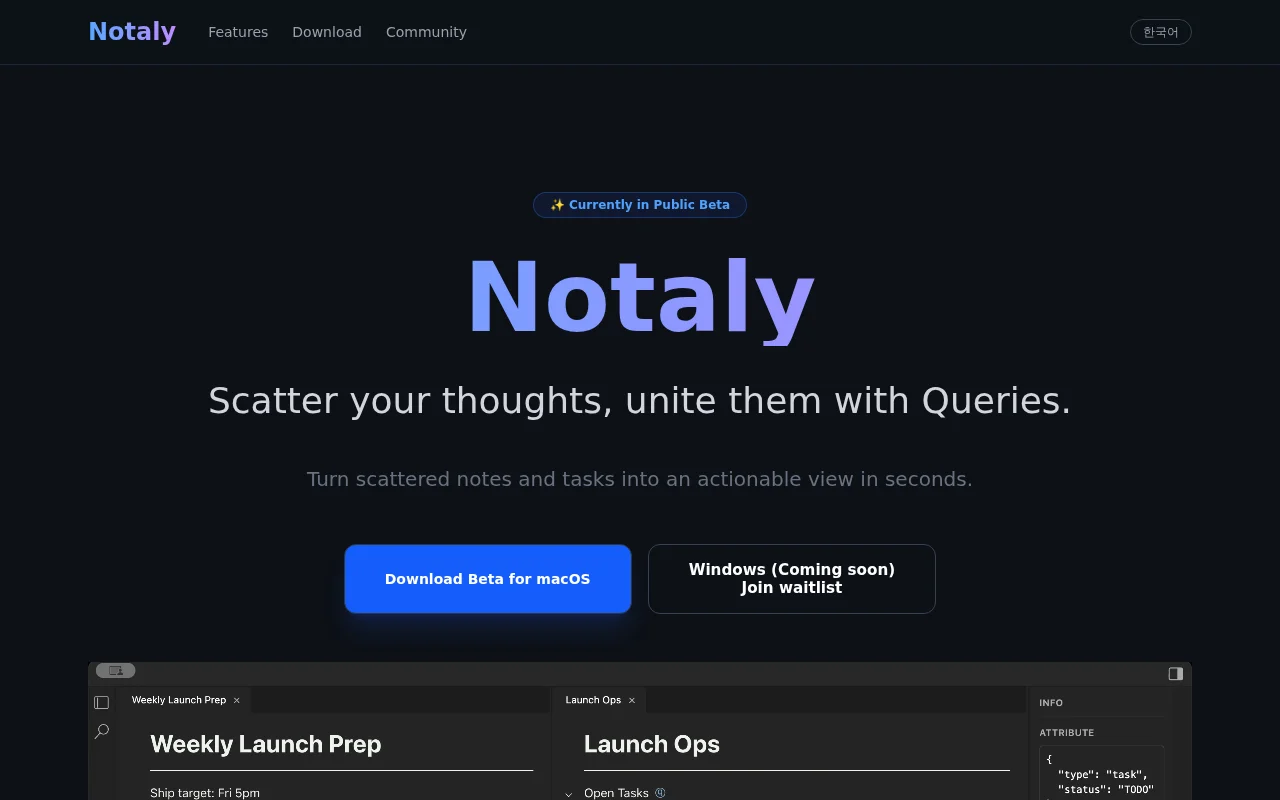
I built a desktop note app called Notaly.
Most note apps assume you should organize everything upfront — folders, tags, backlinks, hierarchies. In practice, I found myself either over-organizing or not organizing at all.
Notaly is built around a different idea: write freely, mark lines as data, and query them later.
You don’t decide where notes belong. You decide what a line means.
For example: - I write meeting notes, study notes, random thoughts — anywhere. - When a line represents something actionable, I mark it as a TODO. - Queries automatically collect those TODOs across all pages into one live view.
There’s no dedicated “task page” or manual linking. Queries always reflect the current state of your notes.
Key ideas: - No upfront structure - Local-first desktop app - Markdown-based - Queries over folders or tags
It’s still early, and I’m actively refining the query model and UX. I’d love feedback on whether this mental model makes sense and where it breaks.
Short demo video on the landing page: https://notaly.dev
Thanks for reading.
Hierarchy emerges by subdivision, but Obsidian plugins already auto-tag and link notes.
Notion meets Obsidian Canvas, but nothing here those don't already do.
Therapy notes AI that skips session recording to avoid privacy nightmares.
Ephe for the terminal, but terminal note apps already exist in dozens of flavors.
Turns Telegram search into a geo-index using compact coordinate hashtags.
Process inspection auto-detection for Zoom and Teams is a genuinely clever local-first trick.