Developer Tools●●Solid
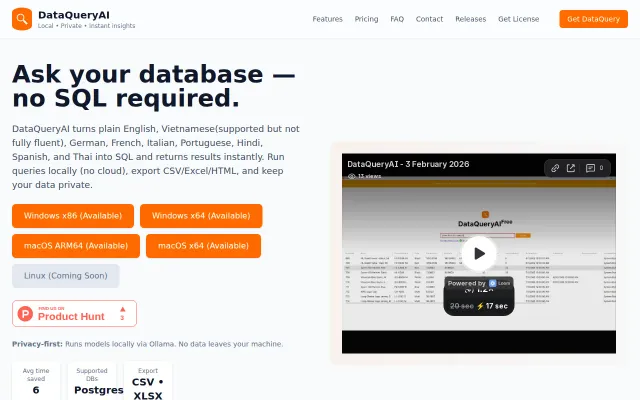
DataQueryAI – Turn plain text into SQL locally
Local-first natural language SQL beats cloud alternatives, but text-to-SQL is a crowded space.
Solve My ProblemNiche Gem
powerwild
103mo ago
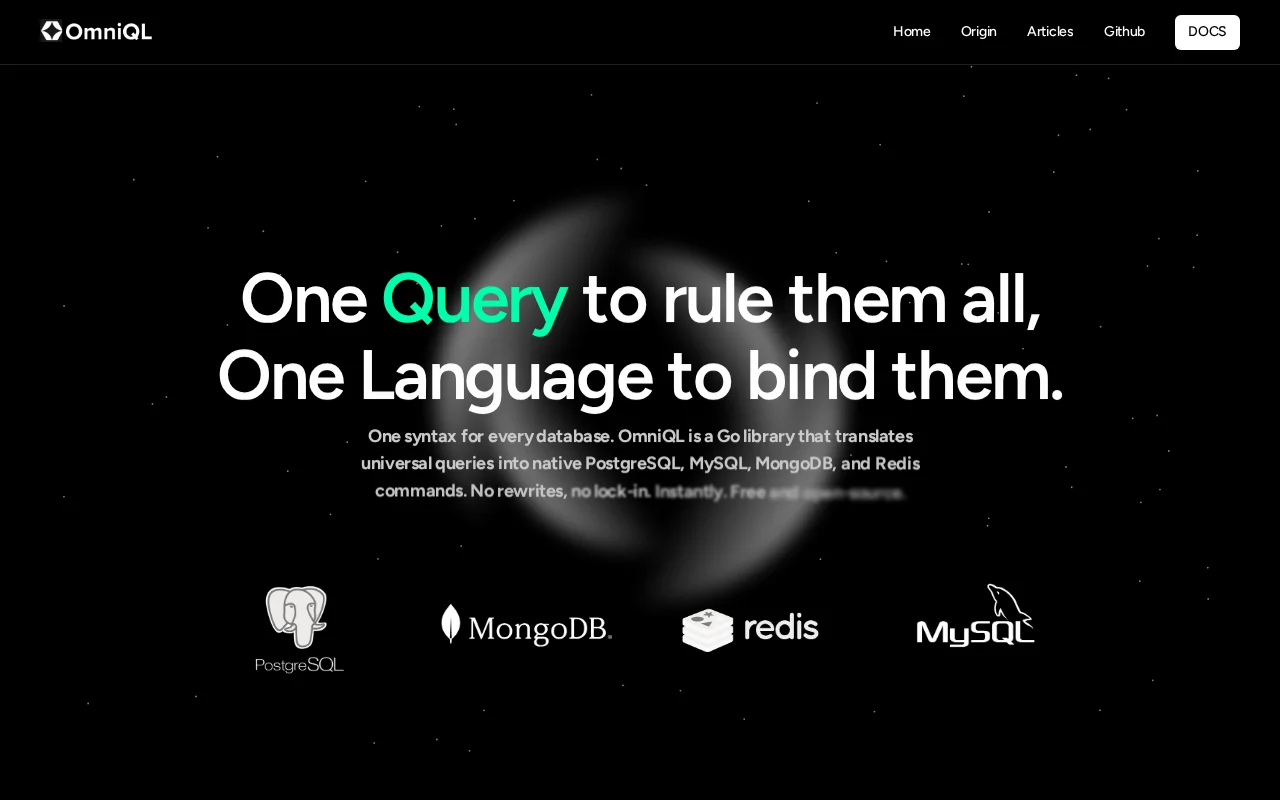
Universal syntax sounds neat until you hit MongoDB's document model vs SQL.
Backend developers managing multi-database platforms
Prisma (multi-DB ORM) · TypeORM · Sequelize
You write: :GET User WHERE id = 42
It becomes: PostgreSQL → SELECT * FROM "users" WHERE "id" = 42; MongoDB → db.users.find({ id: 42 }); Redis → HGETALL users:42
It's a compiler, not a wrapper. Your query becomes an AST, then translates to native commands. No runtime overhead — it generates the same query you'd write by hand.
Works for DDL too: :CREATE TABLE User WITH id:AUTO, name:STRING:NOTNULL
Becomes native CREATE TABLE for Postgres/MySQL or db.createCollection for MongoDB.
Why I built this: I run a multi-database platform and got tired of maintaining four different query syntaxes. OmniQL started as an internal tool and we're open-sourcing it.
GitHub: https://github.com/omniql-engine/omniql Docs: https://docs.omniql.com
Happy to answer questions about the compiler architecture, AST design, or how we handle the semantic gaps between SQL and NoSQL.
Local-first natural language SQL beats cloud alternatives, but text-to-SQL is a crowded space.
It gives Claude/Cursor-style assistants a single set of MCP actions (query, list_collections, describe_collection) across SQL, NoSQL and analytics stores, and smartly defaults to read-only so you don't accidentally mutate production. Configuration via env vars or the Claude CLI plus an extensible McpConnector interface makes it a pragmatic, low-friction tool for LLM tooling — more adapters, auth examples (IAM for Athena) and docs would push it further.
240k Docker pulls and most-starred backup repo, but GFS retention is the only novelty here.
Yet another auth library when Clerk and Casbin already dominate the space.
Docker-friendly database backup UI, but Veeam and pg_dump cover these cases.
Type-safe Postgres queries with zero verbosity, but competes with Prisma, Drizzle, sqlc.