AI/ML●Mid
Skills for spec-driven AI software development
Curated skill collection for spec-driven AI development, competing with other prompt libraries.
Niche Gem
puristajs
202mo ago
Natural language is often ambiguous. Writing code directly with LLMs can be brittle and hard to verify. This skill explores a middle ground: math-style specs (sets, relations, invariants) that agents can turn into architectures, APIs, and tests.
Math-spec approach for LLM-generated code, but lacks working examples and doesn't solve the reasoning-accuracy problem.
Backend/systems engineers using LLMs to generate code for complex, mission-critical specifications.
Alloy (formal modeling language) · TLA+ (temporal logic specification)
Curated skill collection for spec-driven AI development, competing with other prompt libraries.
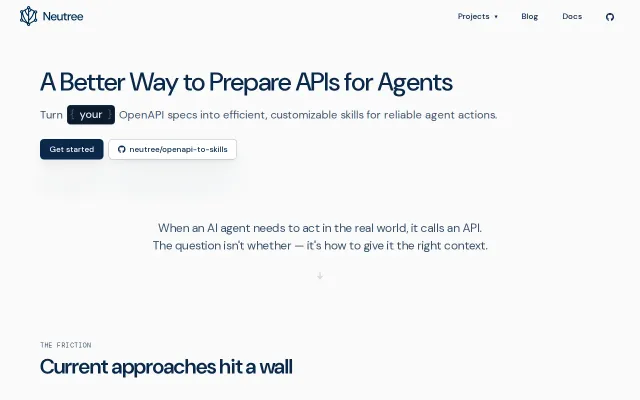
It extracts focused, executable operations from giant OpenAPI files (the GitHub REST YAML is shown) to shrink context and avoid sidecar adapter sprawl — a pragmatic answer to token bloat and brittle ad-hoc integrations. Useful and concrete: if it actually generates tidy, updateable skill units and runtime hooks it saves a lot of maintenance. That said, the idea competes with existing LangChain/openai-function patterns; the repo will need clear runtime, versioning, and update strategies to feel like more than a nicer converter.
Spec-driven workflow generator for Claude Code when prompt-chaining dominates AI coding.
Another spec framework competing with GitHub's spec-kit but as a skill file.
Fix task 14 of 30 without restarting—Cursor's all-or-nothing approach can't do this.
Progressive disclosure beats MCP tool flooding for large OpenAPI specs.