AI/ML●Mid
Phase Router – capacity-aware routing for MoE
Specialized routing logic for MoE models without a demo or benchmarks.
Niche Gem
TSltd
513mo ago
Plano is an AI-native proxy server and data plane for agentic apps. Smart LLM routing, observability, agent orchestration, and guardrails so you stay focused on your agents core logic.
This stitches Arch-Router into Plano so OpenClaw traffic can be steered to different models by task preference — e.g., cheap k2.5 for calendar/email and Opus 4.6 for heavy app-building — which is a sensible, pragmatic way to shave inference costs without manual swapping. The demo looks usable (config.yaml + README + diagram) but stops at integration; I'd like to see performance/latency comparisons, failure handling and more real-world routing rules before I'd trust it in production.
Backend developers, hobbyists and tinkerers running personal AI assistants (OpenClaw users), AI/ops engineers wanting per-request model routing and cost control
OpenClaw is notorious about its token usage, and for many the price of Opus 4.6 can be cost prohibitive for personal projects. The usual workaround is “just switch to a cheaper model” (Kimi k2.5, etc.), but then you are accepting a trade off: you either eat a noticeable drop in quality or you end up constantly swapping models back and forth based on usage patterns
I packaged Arch-Router (used by HF: https://x.com/ClementDelangue/status/1979256873669849195) into Plano and now calls from OpenClaw can get automatically routed to the right upstream LLM based on preferences you set. Preference could be anything that you can encapsulate as a task. For e.g. for daily calendar and email work you could redirect calls to k2.5 and for building apps with OpenClaw you could redirect that traffic to Opus 4.6
This hard choice of choosing one model over another goes away with this release.
Specialized routing logic for MoE models without a demo or benchmarks.
Protocol-first routing contract beats ad-hoc LiteLLM configs for hybrid AI deployments.
Cache-aware LLM routing that doesn't burn prompts to save pennies.
LLM cost routing with LoRA awareness when LiteLLM already handles basic proxying.
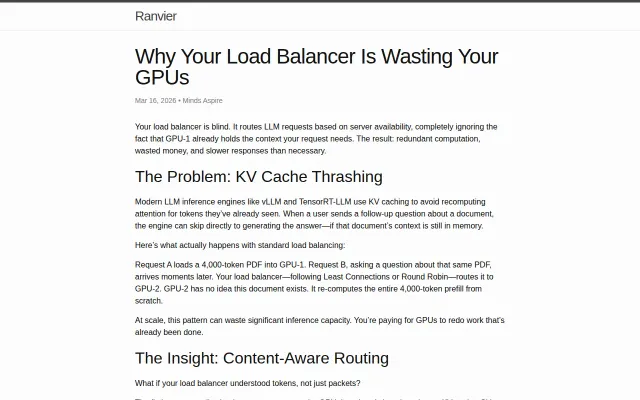
Routes LLM requests to GPUs with cached KV prefixes, skipping redundant prefill computation.
Another human feedback API competing with Prolific and Scale AI.