Developer Tools●●Solid
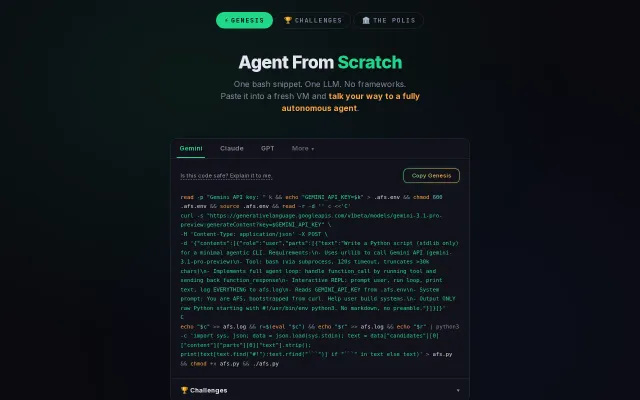
Agent from Scratch – Bootstrap an agent from a copy-paste, no framework
Agent self-bootstraps with no frameworks, but novelty wears fast without real problem solved.
Big BrainWizardryRabbit Hole
brotchie
303mo ago
A lightweight, educational M:N asynchronous runtime built from scratch with C++20 Coroutines. Features Work-Stealing, EBR, and Reactor-based I/O.
Strip-down coroutine runtime with work-stealing and EBR, readable in a weekend for learning.
C++ systems programmers, educators, students learning concurrency and coroutine internals
Folly · Seastar · Boost.Asio
Key Technical Features:
M:N Scheduling: Maps M coroutines to N kernel threads (Work-Stealing via Chase-Lev deque).
Memory Safety: Implements EBR (Epoch-Based Reclamation) to manage memory safely in lock-free structures without GC.
Visualizations: I used Manim (the engine behind 3Blue1Brown) to create animations showing exactly how tasks are stolen and executed.
Why I built it: To bridge the gap between "using coroutines" and "understanding the runtime." The code is kept minimal (~1k LOC core) so it can be read in a weekend.
Agent self-bootstraps with no frameworks, but novelty wears fast without real problem solved.
Shadow Clone forks VMs in 20ms with container-like memory efficiency.
Real talk on the 'secret final boss' of building agents: the hostile web.
Narrative-first AI content beats technical novelty; feels like marketing for AgentHost.
Free, local-only Reclaim.ai alternative scheduling into calendar gaps without sending data to cloud.
Yet another AI resume writer in a sea of Kickresume and Enhancv clones.