Security●●Solid
CargoWall – eBPF Firewall for GitHub Actions
eBPF firewall for GitHub Actions stops supply chain attacks at the kernel level.
Big BrainSolve My Problem
caleblloyd
1422mo ago
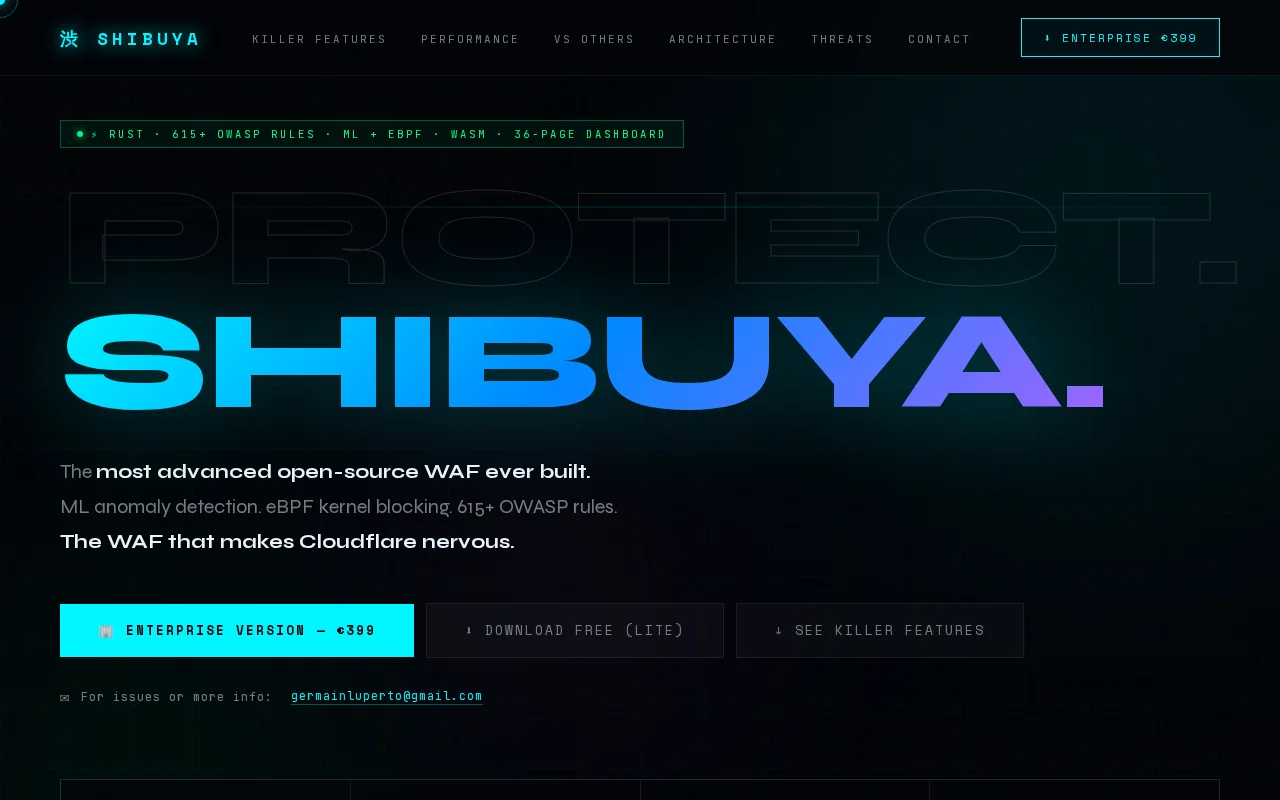
eBPF kernel drops + dual ML engine beats Cloudflare in latency, single microsecond blocks.
DevSecOps engineers, infrastructure teams, enterprise security ops evaluating WAF alternatives
ModSecurity · Cloudflare WAF · AWS WAF
I’ve been working on Shibuya, a next-generation Web Application Firewall (WAF) built from the ground up in Rust.
I wanted to build a WAF that didn't just rely on legacy regex signatures but could understand intent and perform at line-rate using modern kernel features.
What makes Shibuya different:
Multi-Layer Pipeline: It integrates a high-performance proxy (built on Pingora) with rate limiting, bot detection, and threat intelligence.
eBPF Kernel Filtering: For volumetric attacks, Shibuya can drop malicious packets at the kernel level using XDP before they consume userspace resources.
Dual ML Engine: It uses an ONNX-based engine for anomaly detection and a Random Forest classifier to identify specific attack classes like SQLi, XSS, and RCE.
API & GraphQL Protection: Includes deep inspection for GraphQL (depth and complexity analysis) and OpenAPI schema validation.
WASM Extensibility: You can write and hot-load custom security logic using WebAssembly plugins.
Ashigaru Lab: The project includes a deliberately vulnerable lab environment with 6 different services and a "Red Team Bot" to test the WAF against 100+ simulated payloads.
The Dashboard: The dashboard is built with SvelteKit and offers real-time monitoring (ECharts), a "Panic Mode" for instant hardening, and a visual editor for the YAML configuration.
I'm looking for feedback on the architecture and the performance of the Rust-eBPF integration.
eBPF firewall for GitHub Actions stops supply chain attacks at the kernel level.
Kernel-level agent sandboxing via eBPF, but alpha code with kernel panics and unproven reliability.
Six eBPF kernel programs block attacks at wire-speed before Falco even sees them.
Direct eBPF kernel tracing beats slow CLI probing for AI sysadmin tasks.
eBPF behavioral detection catches miners spoofing thread names without signature databases.
eBPF-based USB sniffer bypasses usbmon entirely using universal URB hooks for zero-setup debugging.