Security●Mid
Raypher – a Rust-Based Kernel Driver to Sandbox "Bare Metal" AI Agents
Kernel-level agent sandboxing via eBPF, but alpha code with kernel panics and unproven reliability.
Bold BetWizardry
Kidiga
103mo ago
Pasport like identity for AI agents anchored to the TPM chip and the Intent-Bound Ephemeral Visa for AI agents
TPM-anchored agent identity solves a real problem, but product is vaporware—coming soon, no code yet.
DevOps engineers, security-conscious developers, enterprise CISO teams running local AI agents
Sandbox/container isolation (Docker, Firecracker) · SELinux/AppArmor policy engines · AWS IAM + credential scoping
Most of us want to run autonomous agents (like OpenClaw or LangChain) locally on our daily-driver machines so they can actually interact with our IDEs and real workflows.
But giving a non-deterministic, hallucination-prone script raw access to your host OS is basically local remote code execution. It’s a matter of time before an agent wipes a directory or leaks an SSH key.
The current workarounds are terrible:
Containers: Shoving the agent in Docker completely lobotomizes it. It can no longer see or interact with your actual host OS where your real work lives.
The Hardware Air-Gap: Buying a dedicated Mac Mini or a cheap secondary laptop just to run agents safely is an expensive band-aid.
The Cloud: Spinning up a VPS adds annoying latency, costs monthly fees, and kills the "local-first" speed advantage.
I got fed up and built Raypher.
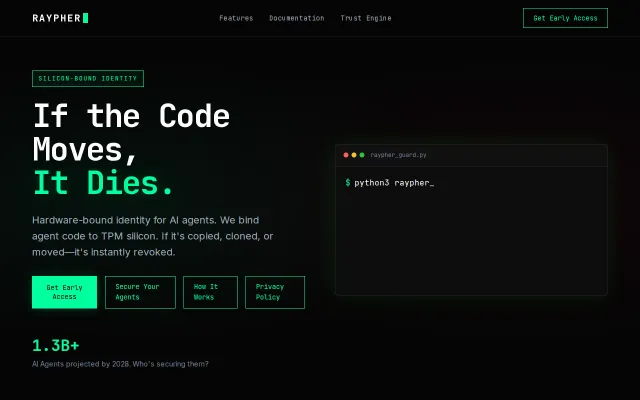
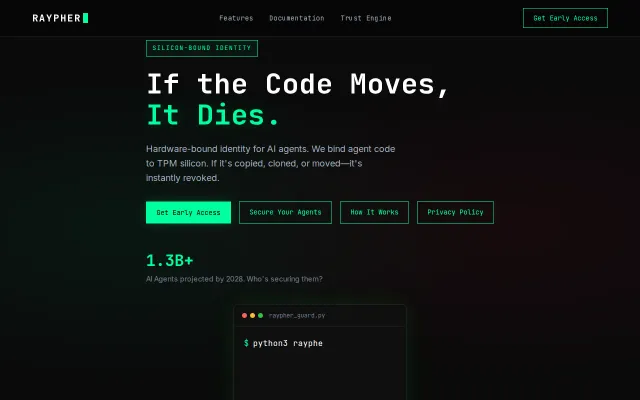
Raypher is a bare-metal security architecture specifically designed for AI agents. It lets you run agents directly on your host machine while keeping them on a cryptographically tight leash.
How the Alpha works under the hood:
Hardware Identity: We bind the agent's session cryptographically to your physical TPM 2.0 chip. If the agent is hijacked or moved to another machine, the keys fail.
Zero-Touch Interception: You don't have to rewrite your Python/Node agent scripts. Raypher currently uses transparent system proxy injection (netsh portproxy on Windows) to catch all agent traffic automatically.
The Policy Engine & DLP: Every request is evaluated locally. If it tries to phone home to an unapproved domain, it gets blocked. It also runs local DLP to automatically redact API keys before they hit the network stream.
(Transparency note: To maintain system stability for early testers, this MVP uses system proxy injection. The heavy kernel-level eBPF/WFP hooks are currently in development, but this Alpha proves the hardware-bound Policy Engine actually works).
Kernel-level agent sandboxing via eBPF, but alpha code with kernel panics and unproven reliability.
eBPF kernel hooks enforce agent boundaries at <0.05ms latency; no API polling tax.
TPM-bound agent identity solves a real pain, but execution is pre-launch vaporware.
Package-based platform architecture using OCI artifacts — OpenStack for the Kubernetes era with CNCF backing.
Closes a real gap: local AI on Mac needs hardening, but nobody audits default-insecure Ollama/OpenClaw setups.
Deterministic policy engine blocks agent actions without relying on fragile LLM guardrails.