SaaS●●Solid

Custom Pricing Units in Flexprice (price in credits, bill in USD)
Custom pricing units solve real credit/token billing chaos, but Stripe + Chargebee already do this.
Solve My ProblemShip It
ShreyaChaurasia
504mo ago
Solana devnet credit primitive, but devnet-only and unproven vs. existing RWA infrastructure.
DeFi developers, credit market builders, Solana ecosystem
Maple Finance · Clearpool · Aave Credit Delegation
The aim is to create a simple, transparent building block for credit markets, without reproducing the opacity and fragmentation of legacy credit infrastructure.
What’s live now
• Public Solana devnet deployment • Cross‑wallet trading (buy in one wallet, sell in another) • Deterministic issuance and settlement logic • Seller‑maintenance invariant enforced on‑chain • Next.js UI + Rust/Solana backend • Supabase for activity history • Clean, documented architecture
Why this exists
Credit markets today are:
• opaque • slow • fragmented • inaccessible to most participants
CUs are an attempt to provide:
• standardized credit exposure • transparent pricing • atomic settlement • open participation • a foundation for indices, baskets, and structured products
Think of it as credit exposure as a first‑class on‑chain asset, rather than a derivative bolted onto an AMM.
Who I’m looking for Not testers or airdrop hunters — the system already works.
I’m looking for: • engineers who enjoy building financial primitives • Solana/Rust developers • people interested in credit, risk, or market structure • contributors who want to help shape an early system
Try it out
Repo: https://github.com/zippy2261-lgtm/credit-units Live devnet UI: https://credit-units-ui.vercel.app Docs: https://pukw8vrkvrdfqd4h.public.blob.vercel-storage.com/PUBL...
Feedback that would be most helpful
• architecture and invariants • UX flow • economic logic • potential integrations • edge cases • contributor experience
This is early, but real. If you’re interested in credit markets, Solana, or financial infrastructure, I’d appreciate your thoughts.
Custom pricing units solve real credit/token billing chaos, but Stripe + Chargebee already do this.
Genetic algorithms for energy optimization when linear programming dominates the field.
Finally, an AI design partner that edits vector layers instead of generating static images.
VLMs handle messy emerging market documents where Plaid and generic OCR fail.
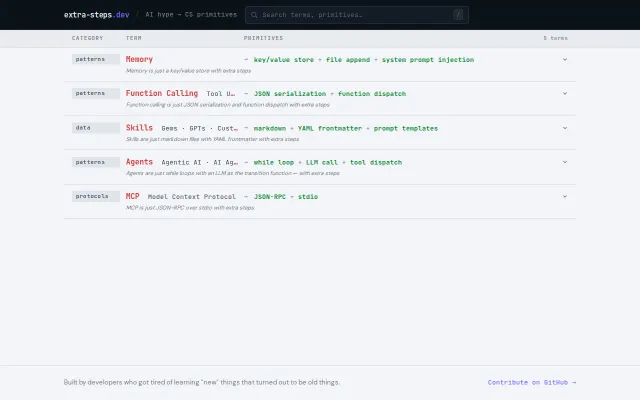
Each entry uses the blunt formula “X is just Y with extra steps” and ships expandable pseudocode plus citations, which makes it shockingly useful for clarifying debates in product or architecture meetings. The origins pages (Docker, Kubernetes, MCP) show historical depth instead of mere snark, so it feels like a tiny citadel of common-sense explanations rather than another buzzword glossary.
MCP server for credit cards is clever but only works if you have a Klutch card.