Developer Tools●●●Banger
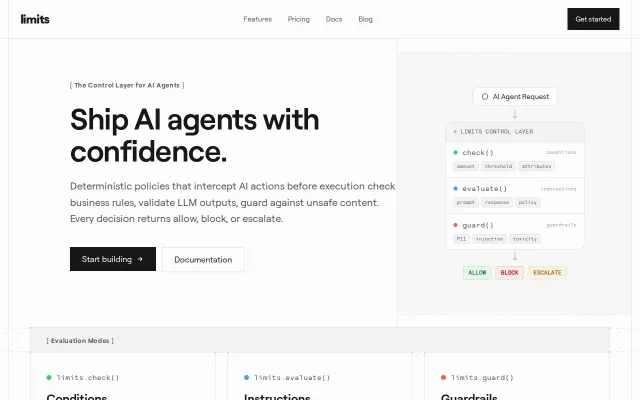
Limits – Control layer for AI agents that take real actions
Wire-protocol interception means zero code changes; solves LLM control drift in production.
Solve My ProblemSlick
thesvp
925mo ago
CORD — Constitutional AI safety engine for autonomous agents. Hard blocks, risk scoring, real-time audit. 482 tests.
Wire-protocol middleware for LLM safety, but constitutional AI has dozens of frameworks.
AI engineers building autonomous agents, MLOps teams deploying language models
Anthropic Constitutional AI · OpenAI Moderation API · Guardrails AI
Wire-protocol interception means zero code changes; solves LLM control drift in production.
Sandbox agents via natural-language policy, not ambient authority—genuinely novel approach.
Constitutional governance for AI agents beats prompt injection with pre-execution enforcement.
Governance rules live in version-controlled YAML and can be applied either by decorating functions with @sanna_observe or by dropping a gateway between an MCP client and downstream tools. It emits portable Ed25519-signed receipts you can persist and verify, which is a neat, practical way to build an auditable trail — the tough part will be ecosystem adoption around MCP and agent integrations.
The README actually lays down concrete design choices: four cell types (Transformer, Reactor, Keeper, Channel), a Universal Contract with Intent Ledgers, and Merkle-based signatures plus a constitutional validator. Interesting on paper, but the repo looks embryonic — the quickstart is truncated, there are no releases or demos, and the bold architectural claims outpace the visible implementation.
Constitutional enforcement blocks AI agent violations at runtime, but unclear if practical for most teams.