Security●●●Banger
Nobulex – Cryptographic receipts for AI agent actions
Proof-of-behavior for AI agents before Anthropic or OpenAI build their own.
Zero to OneBig BrainBold Bet
arian_
101mo ago
ZK proofs for agent audits—sidesteps proving LLM correctness by proving auditor honesty instead.
AI ops teams, enterprises running multi-agent systems in high-stakes environments (finance, healthcare, incident response).
Anthropic's Constitutional AI (alignment framework) · OpenAI's Evals (agent testing) · Deimos Labs' zkML
I kept hitting the same issue. I couldn't get a rules-based system to enforce behavior and I had no real way to prove that agents really did what they said they did. I can log and monitor them - set up (a million) Slack alerts but none of these things are PROOF. Logs are mutable. And that matters more every day as agents get more powerful (take THAT, @meta)
So I went down the rabbit hole.
The obvious answer is zero-knowledge proofs. Prove behavior cryptographically. Except proving an LLM inference in a zkVM is computationally Star Trek. Lagrange proved GPT-2 E2E, Polyhedra can do Llama-3 at 150 seconds per token — production-scale is still hours, not seconds.
The a-ha: I don't need to prove the model is correct. I need to prove the auditor is honest.
My system intercepts agent thinking blocks (Claude, OpenAI, Gemini), analyzes them against a behavioral contract, and produces a verdict: clear, review needed, or boundary violation. That derivation is deterministic — ~10,000 RISC-V cycles. Provable today.
So I built a guest program inside SP1's zkVM (on Modal) that re-derives the verdict from scratch, ignoring what the auditor claimed, and generates a STARK proof. If the auditor said "clear" but the evidence warranted "violation," the proof fails. The auditor cannot lie.
Quis custodiet ipsos custodes (Who watches the watchmen?) — answered with math. Sub-second on GPU.
OK... pretty cool, but what ELSE can you do with it?
Great question! Once I had provable individual verdicts: what about teams? Can I prove the group is safe?
I ended up applying financial risk theory to AI agent fleets (things I never expected to be doing with my life). CoVaR for tail risk — one bad agent in a group of four good ones doesn't average out to "fine." Markowitz portfolio theory for coherence — treating value alignment like diversification. DebtRank for contagion — if Agent A fails, who's exposed? Originally designed for bank failures. Works disturbingly well for agents.
Then I needed Shapley attribution for individual risk. Except real Shapley is exponential (2^n subsets), and Monte Carlo introduces randomness. Randomness = non-determinism = unprovable in a zkVM. Leave-One-Out approximation: deterministic, O(n²), the only Shapley variant that works inside a prover.
Oh, and all of it runs in Q16.16 fixed-point arithmetic (i32) because floating-point produces different results on different architectures, and "different results" inside a zkVM = worthless proof. I implemented exp, sqrt, and clamp from scratch in integer math. Casting spells at 2 AM in the dark again.
The whole stack — CoVaR, Markowitz, DebtRank, Shapley, circuit breakers — computes in TypeScript on Cloudflare Workers (instant), then re-derives in Rust inside the zkVM (provable). Both produce identical results. If they don't, something is very wrong.
So what?
Every agent accumulates cryptographically attested checkpoints — Ed25519 signatures, SHA-256 hash chains, Merkle trees, STARK proofs — and earns a Trust Score. Credit rating for AI agents, AAA to CCC. The score isn't an opinion. It's a computation over evidence anyone can independently verify. FICO computes scores from data you can't inspect. This computes scores from data anyone can cryptographically verify.
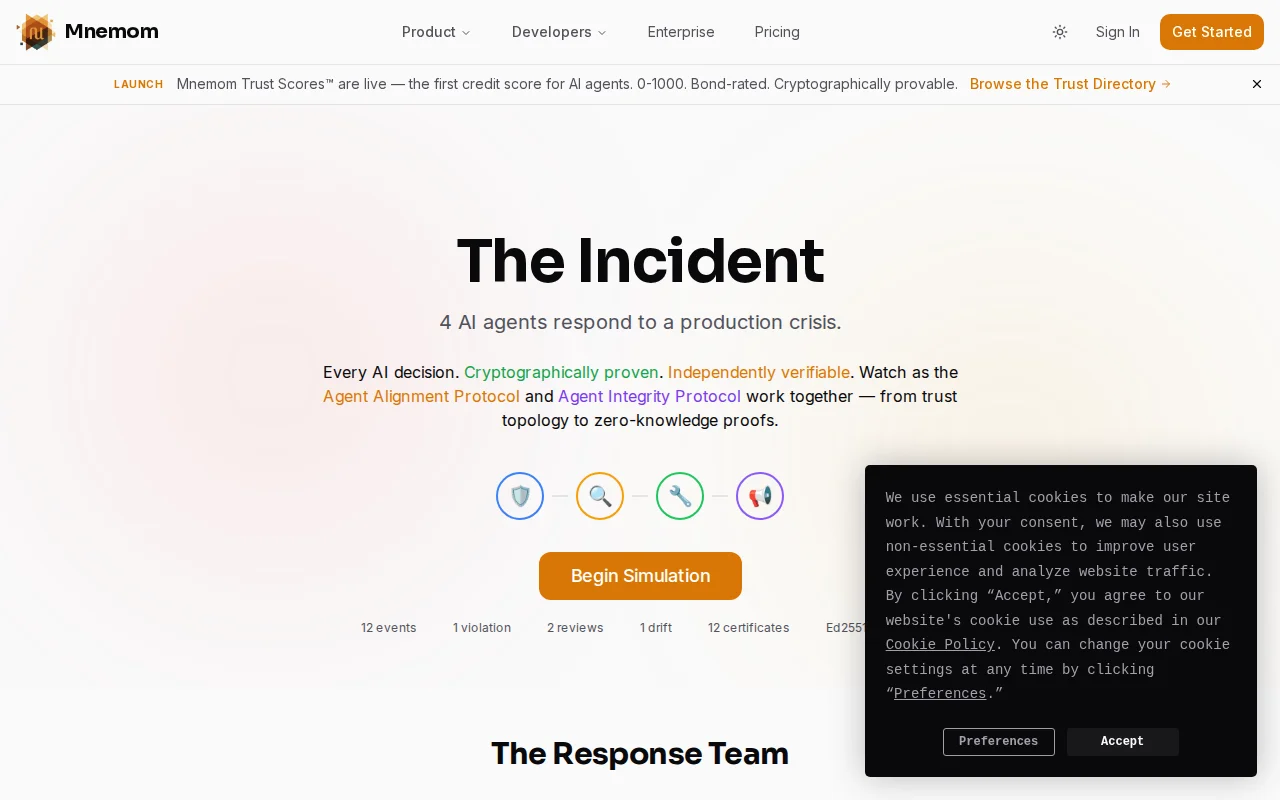
Everything I described here is live code. Four agents handling a production incident — coherence matrix, trust topology, Merkle visualization, drift detection: https://mnemom.ai/showcase
Apache-licensed. Zero-code gateway: npm install -g @mnemom/smoltbot && smoltbot register
GitHub: github.com/mnemom | Docs: docs.mnemom.ai
Proof-of-behavior for AI agents before Anthropic or OpenAI build their own.
Lyapunov stability theory for LLM loops beats hard budget caps any day.
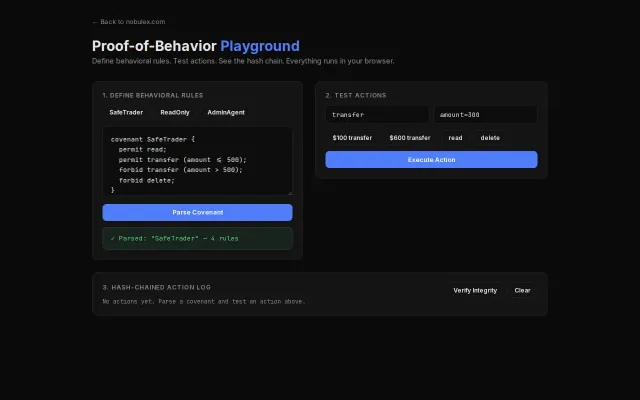
Hash-chained action logs prove what AI agents actually did, not what they claimed.
Lyapunov stability theory catches token spirals before your budget explodes.
Cryptographic proof of human approval for agent actions—solves a real gap in agent safety architecture.
Hybrid post-quantum signatures verifying agent auth offline in under a millisecond.