Education●Mid
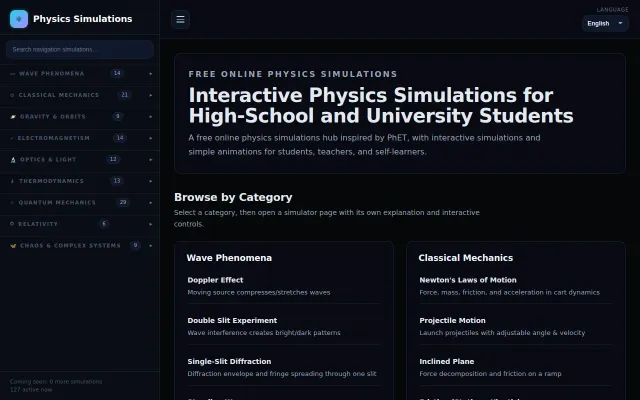
Interactive Physics Simulations Hub built with AI
PhET clone with 127 simulations, but no novel pedagogy or technical differentiation.
Crowd Pleaser
onion92
104mo ago
Python SDK for WaveGuard physics-based anomaly detection API. One call. Any data.
Physics-based anomaly detection with no training step, but novelty doesn't match execution maturity.
Data engineers and ML practitioners needing anomaly detection without model training.
PyOD · scikit-learn isolation forest · Datadog Anomaly Detection
How it works: data gets encoded onto a lattice, a wave equation evolves it on a GPU (NVIDIA T4), and anomalies show up as regions where wave energy concentrates. It also returns the top features explaining WHY each point was flagged.
What's different from sklearn/PyOD: - Stateless: training + inference in one API call - GPU-accelerated: CUDA kernels, not Python loops - Explainable: per-feature contribution scores, not just a number - Works on anything: JSON, time series, text, tabular
Free tier: 100 scans/day, no key needed.
Python SDK: pip install WaveGuardClient MCP server: works with Claude Desktop / AI agents via Smithery Docs: https://github.com/gpartin/WaveGuardClient
Try it in 4 lines: from waveguard import WaveGuard wg = WaveGuard() result = wg.scan(training=[{"cpu": 45}, {"cpu": 50}], test=[{"cpu": 99}]) print(result.summary)
PhET clone with 127 simulations, but no novel pedagogy or technical differentiation.
Pretty WebGL water demo, but ripple physics are well-trodden territory.
Claude talks to RunPod/Lambda/Lambda/Vast — but needs working provider integrations to matter.
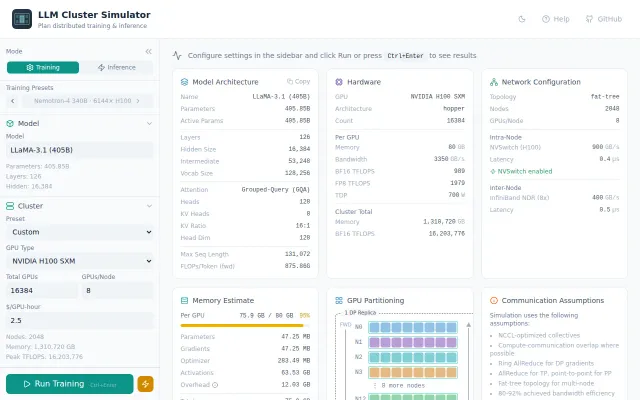
Estimates LLM training MFU, memory, timeline across 70 models and parallelism strategies—genuinely useful before GPUs commit.
WebGPU force-directed graphs, but Sigma.js, Cytoscape, and D3 already dominate this space.
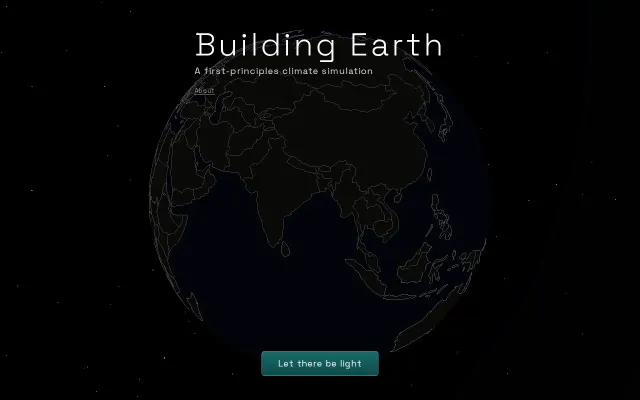
Layer-by-layer climate physics you can actually watch unfold in 3D.