Infrastructure○Pass
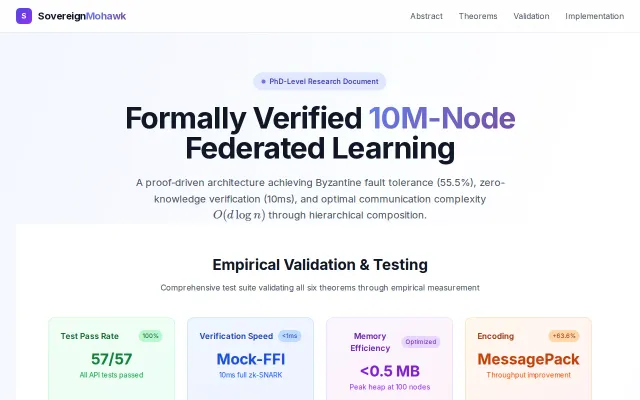
I solo-built Sovereign-Mohawk – FL with 500K nodes and 55% BFT
Math-heavy claims without credible evidence of 500K-node stress test.
rwilliamspbgops
123mo ago
Sovereign Map is a production-grade, Byzantine-tolerant Federated Learning framework. Utilizing the Mohawk Protocol for streaming aggregation, it achieves a 224x memory reduction, enabling secure orchestration of 100M+ nodes via TPM 2.0 hardware-rooted trust. Features full-stack observability with Prometheus & Grafana, built-in tokenomics telemetry
10M-node Byzantine FL is impressive; but GitHub release lacks runnable code or verifiable benchmarks.
Distributed systems researchers, privacy engineers, decentralized AI infrastructure builders
HoneyBadgerBFT · Federated Learning framework (TensorFlow Federated) · Cosmos SDK
It maintains 82% accuracy even when 5 million nodes are malicious.
Here's what happened ↓
---
*The Test (Feb 24, 2026)*
10,000,000 nodes 4,000,000 - 5,000,000 malicious (Byzantine) nodes 59 minutes 41 seconds total runtime 100% success rate
Results: • 40% Byzantine (4M bad): 83.3% accuracy • 50% Byzantine (5M bad): 82.2% accuracy
---
*Why this matters*
Google's federated learning papers max out at ~10K nodes in production.
Academic Byzantine fault tolerance systems (HoneyBadgerBFT, etc.) are tested at 100-1K nodes.
I just validated 10M nodes with 50% malicious participation—solo, in under an hour.
---
*Scaling proven across 5 orders of magnitude*
100 nodes → 10M nodes O(n log n) holds perfectly Streaming aggregation prevents memory death Per-round time: 127-154 seconds at 10M scale
---
*The stack*
- Rust/Go core (MOHAWK protocol) - Python SDK - WebAssembly edge runtime - zk-SNARK verification (<1ms) - Hardware root of trust (TPM 2.0) - Hierarchical batching for extreme scale
---
*Solo dev context*
Built this alone. 5 hours of continuous testing today. 135KB documentation. 100% test pass rate.
No $10M venture funding. No PhD team. No Google infrastructure.
Just code that works at any scale.
---
*What this enables*
- Global sensor networks (climate, defense, agriculture) - Cross-hospital AI without patient data sharing - Multi-national intelligence collaboration - Autonomous vehicle fleets training together - Any scenario where you can't trust 50% of participants
---
Release: https://github.com/rwilliamspbg-ops/Sovereign_Map_Federated_...
Repo: https://github.com/rwilliamspbg-ops/Sovereign_Map_Federated_...
Looking for: defense pilots, enterprise users, academic collaboration, contributors.
Happy to answer questions.
Math-heavy claims without credible evidence of 500K-node stress test.
Tantivy full-text search with mmap'd index serves 85% of requests from cache in under 1ms.
SQLite with Raft consensus—etcd alternative that actually speaks SQL.
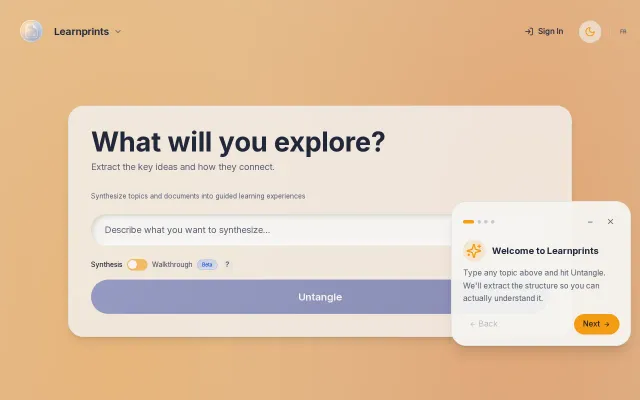
Claude-generated concept blueprints plus spaced repetition, but flashcard learning is crowded.
Rust swarm vs LLM agents is clever positioning, but benchmarks are self-designed and lack third-party validation.
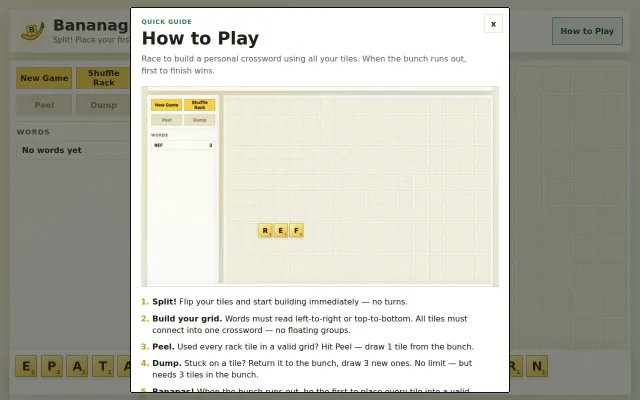
Another Bananagrams clone when several free browser versions already exist.