Developer Tools●Mid
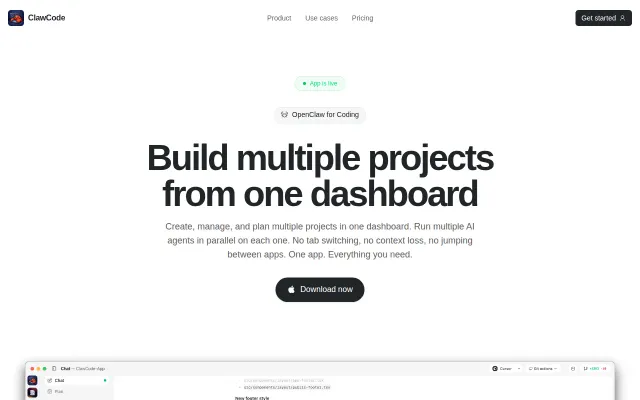
I Made OpenClaw for Coding – ClawCode
OpenClaw wrapper with 12-agent swarm, but MVP-stage claims outpace deliverables and no independent verification.
Bold Bet
pvisilias
103mo ago
Multi-agent parallel research beats context-window limits, but orchestrating agents isn't new.
Knowledge workers, analysts, researchers, business professionals needing bulk structured research at scale.
Claude Projects · Crew AI · AutoGPT
I’ve been working on a system that runs multiple AI agents in parallel to perform structured research instead of generating a single summary response.
One use case I tested recently was stock research.
When you properly research a stock like NVIDIA, you usually open multiple tabs:
- Financials - Earnings reports - Analyst sentiment - Competitors - Recent news - Risks - Market positioning
Most AI tools generate one combined answer, which often becomes shallow or blended.
So I built a workflow execution agents that:
- Spawns multiple specialized agents at once - Assigns each agent a focused responsibility (financials, competitors, risks, etc.) - Runs them in parallel - Normalizes structure - Compiles everything into a single structured research report
Instead of one AI response, you get multiple independent research threads that are merged into a coherent output.
The goal isn’t “better summaries.” It’s structured multi-angle research without manually orchestrating prompts.
Here’s a short demo using NVIDIA stock:
Would love feedback on:
- Does parallel specialization meaningfully improve depth vs single-thread LLM prompts? - Where else would this model be more useful (beyond stock research)? - What would you want to see measured (quality benchmarks, latency, cost breakdown)?
Happy to answer technical questions.
OpenClaw wrapper with 12-agent swarm, but MVP-stage claims outpace deliverables and no independent verification.
Claude Code orchestrator with SSE status detection, PWA dashboard, and tmux isolation—genuinely useful for multi-agent work.
Fire-and-forget Claude orchestration, but only 4 commits and zero stars so far.
Parallel agent branches with PR workflow, but Cursor parallel tabs and Claude do multi-task now.
Spawns dozens of Claude Code agents in tmux with auto-recovery and shared memory—neat hack, niche audience.
Claude orchestration with live dashboards and agent-spawning—well-built but competes with Anthropic, OpenAI infrastructure.