Developer Tools●●Solid
Tag Promptless on any GitHub PR/Issue to get updated user-facing docs
Tags @promptless on PRs; it drafts docs without leaving GitHub or signing up.
Solve My Problem
prithvi2206
3573mo ago
Local-first context ingestion and retrieval for AI tools. SQLite + embeddings + MCP server for Cursor & Claude.
Local RAG without cloud: sync your codebase, search hybrid, feed Cursor via MCP.
Backend developers, AI tool power users managing complex multi-repo projects
Ollama · Perplexity (local context) · Retrieval-augmented generation tools like LlamaIndex
I built this because I kept hitting the same problem: AI tools are powerful but have no memory of my complex multi-repo project. They can't search our internal docs, past incidents, or architecture decisions. Cloud RAG services exist, but they're complex, expensive, and your data leaves your machine. I wanted something I could point at my sources and just run `ctx sync all`.
Quick start:
# Install (pre-built binaries available for macOS/Linux/Windows) cargo install --git https://github.com/parallax-labs/context-harness.git
# Create config and initialize ctx init
# Sync your data sources (filesystem, Git, S3, or Lua scripts) ctx sync all
# Search from CLI ctx search "how does the auth service validate tokens"
# Or start the MCP server for Cursor/Claude Desktop ctx serve mcp
What it does differently from other RAG tools:- *Truly local*: SQLite + single binary. No Docker, no Postgres, no cloud. Local embeddings (bundled or pure-Rust) so semantic and hybrid search work with zero API keys. Back up your entire knowledge base with `cp ctx.sqlite ctx.sqlite.bak`. - *Hybrid search*: FTS5 keyword scoring + cosine vector similarity with configurable blending. Works without embeddings too (keyword-only mode); with local embeddings you get full hybrid search offline. - *Lua extensibility*: Write custom connectors, tools, and agents in Lua without recompiling anything. The Lua VM has HTTP, JSON, crypto, and filesystem APIs built in. - *Extension registry*: `ctx registry init` installs a Git-backed community registry with 10 connectors (Jira, Confluence, Slack, Notion, RSS, Stack Overflow, Linear, etc.), 4 MCP tools, and 2 agent personas. - *MCP protocol*: Cursor, Claude Desktop, Continue.dev, and any MCP-compatible client can connect and search your knowledge base directly.
Embeddings: you can run *fully offline* — the default build uses local embeddings (fastembed with bundled ONNX on most platforms, or a pure-Rust tract path on Linux musl and Intel Mac). No API key required. Optional: Ollama (local LLM stack) or OpenAI if you prefer. Keyword-only mode needs zero deps. There's no built-in auth layer; it's designed for local or trusted network use.
Stack: Rust, SQLite (WAL mode), FTS5, mlua (Lua 5.4), axum, MCP Streamable HTTP. MIT licensed.
GitHub: https://github.com/parallax-labs/context-harness
Docs: https://parallax-labs.github.io/context-harness/
Community Registry: https://github.com/parallax-labs/ctx-registry
If you find it useful, a star on GitHub is always appreciated.
Would love feedback on the search quality tuning (hybrid alpha, candidate counts) and the Lua extension model.
Tags @promptless on PRs; it drafts docs without leaving GitHub or signing up.
Ticket-triggered AI engineer when Cursor, Devin, and Sweep already own this category.
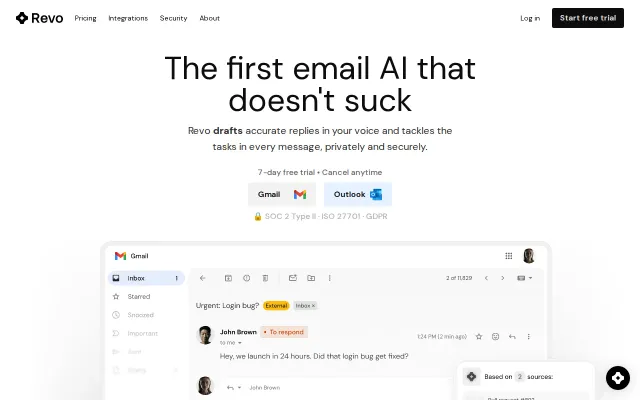
Email AI with multi-tool context, but 'smart email' is a crowded category.
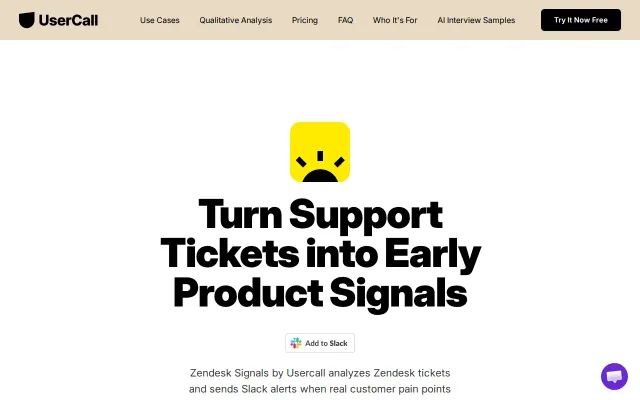
It compares the last 7 days to a 30-day baseline, flags spikes in workaround language, expectation gaps and escalations, and pushes Slack alerts with real customer quotes — the contextual snippets are the product's strongest hook. That said, the page glosses over classifier accuracy, tuning controls, and triage links; in a crowded space this'll live or die on precision and how easily teams can act on the alerts.
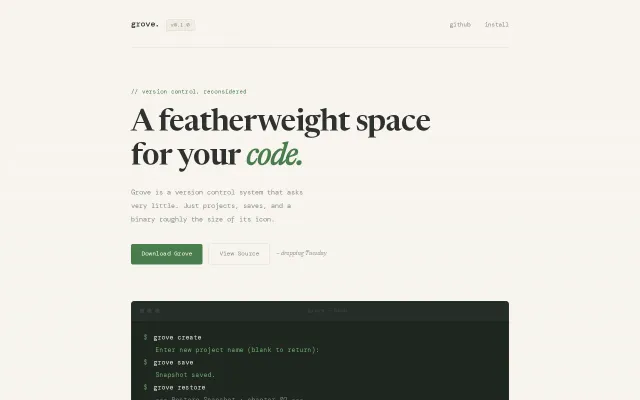
608kb Rust binary, but Git already handles snapshots better.
Full-lifecycle AI dev at $2.5k/mo, but context persistence and code quality TBD post-trial.