Back to browse
GitHub Repository

AI-powered product recommendations using ChromaDB vector search and TensorFlow.js ranking, built on Next.js with 42K+ Amazon products

3 starsTypeScript

A production-style recommender using vector retrieval and re-ranking

by ftonato·Feb 27, 2026·2 points·0 comments

AI Analysis

●●SolidBig BrainRabbit Hole

Teaches retrieval-ranking split that matters at scale, but it's educational scaffolding, not a product.

Strengths
  • Clear pedagogical value: visualizes the latency-recall tradeoff that real systems abstract away.
  • Full pipeline: ingestion → embedding → training → inference, end-to-end reproducible.
  • Honest framing: author asks real questions (K selection, filtering, embedding quality) that most tutorials skip.
Weaknesses
  • No novel technique—two-stage retrieval is a known pattern; Vespa, Weaviate, Pinecone all handle this.
  • Kaggle dataset + toy TFJS model limits insights about real-world scale or A/B testing results.
Target Audience

ML engineers learning production recommender patterns, builders exploring retrieval-ranking architectures

Similar To

Pinecone examples · Weaviate tutorials · Vespa documentation

Post Description

I’ve been exploring how recommendation systems are actually implemented in production, beyond just training models.

A common pattern I kept seeing is to split the problem into two stages:

1. Retrieve a small set of relevant candidates

2. Re-rank them using a model

Instead of doing brute-force inference across all items, I built a small prototype around this idea.

The flow looks like this:

- Store embeddings in a vector database (ChromaDB)

- Retrieve the Top-K most similar items/users based on vector similarity

- Run a TensorFlow.js model to re-rank the candidates

The goal is to reduce the search space before applying inference, which seems necessary when latency and scale matter.

What I found interesting is that once you move to this approach, a lot of the complexity shifts from the model itself to the retrieval layer:

- choosing K

- filtering candidates

- embedding quality

- latency vs recall trade-offs

Curious how others approach this in real systems:

- How do you decide on K?

- Do you rely purely on vector similarity or add heuristics?

- How do you handle re-ranking at scale?

Project: https://github.com/ftonato/recommendation-system-chromadb-tf...
Similar Projects

AI/ML●●Solid

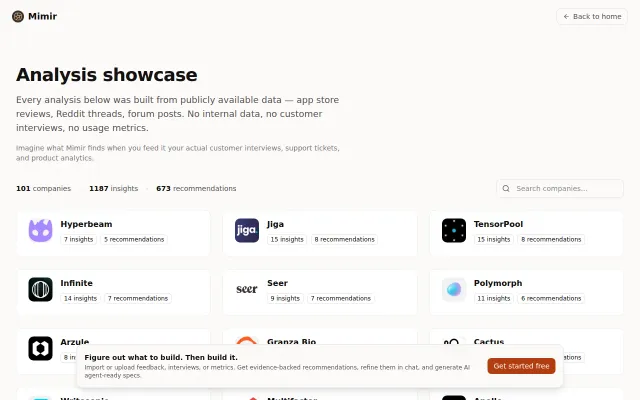
I built a tool that helps YC companies figure out what to build next

It clusters cross-source feedback, ranks themes, and — crucially — links every recommendation back to the original quotes, which makes the output auditable instead of a mysterious LLM blob. You can chat with your dataset and export AI-generated specs and GitHub issues, which pushes discovery straight into execution; my main questions are accuracy on private corp data and how it prevents hallucinated recommendations.

Solve My ProblemSlickBig Brain
schreibertuc
103mo ago