Developer Tools●Mid
webskills – turn any webpage into an agent skill
Webpage-to-agent-skill wrapper when skills add already exists—adds conditional extraction.
Ship It
kstonekuan
203mo ago
Turns PDFs and videos into shareable agent skills—but competitors already exist.
AI engineers, developers building multi-agent systems, organizations with training materials or documentation
Hugging Face Hub · LangChain · Pinecone
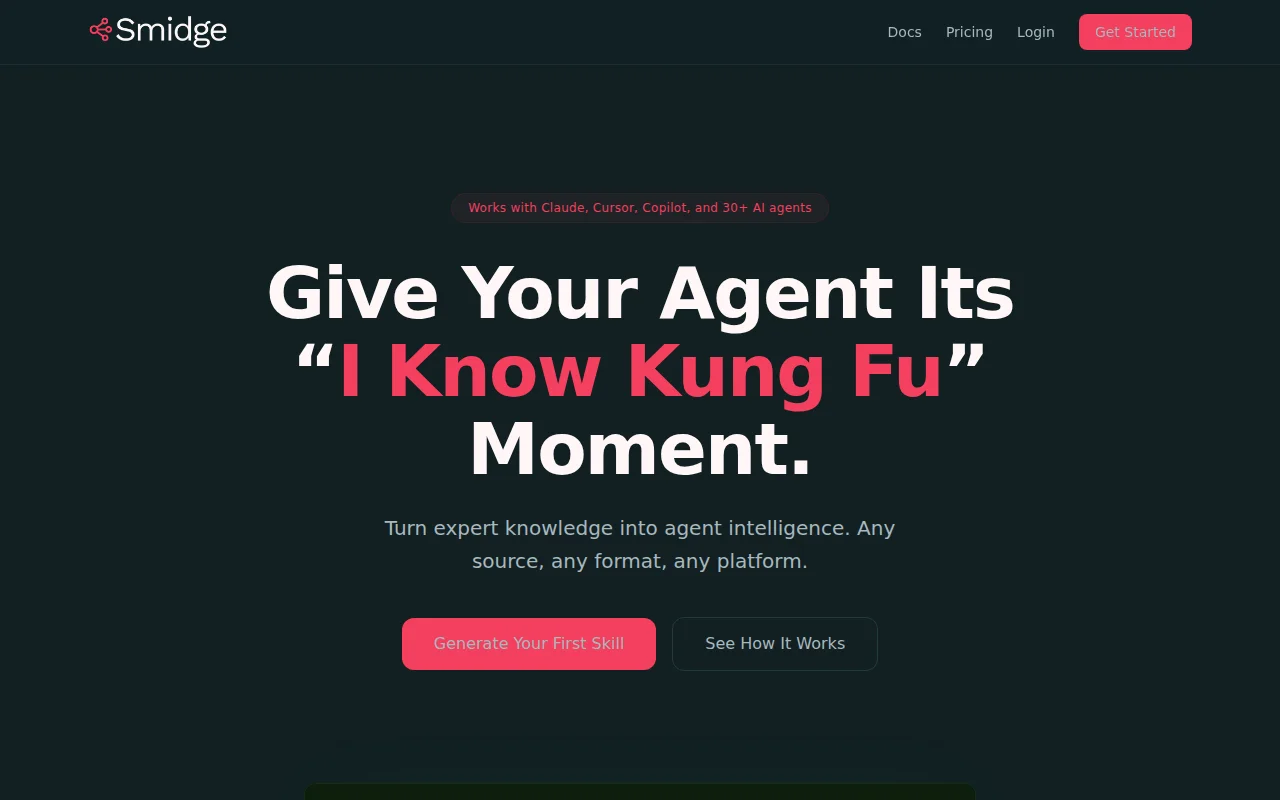
The core idea: your agents should have the same expertise you do, without you manually writing SKILL.md files.
How it works:
Drop source material (YouTube, PDFs, audio, docs, slides, up to 50MB each, multiple sources at once)
Source-aware extraction: transcripts get distilled, papers keep structure, slides get expanded
Automatic skill catalogues: a textbook or manual becomes multiple focused, topic-specific skills
Every skill validated against the Agent Skills spec Download individual skills or full catalogues
CLI: npm i -g smdg-cli smdg generate --source ./docs/brand-guide.pdf
Tech: Next.js, Supabase (Postgres + Auth + Storage), Claude API for extraction, Stripe for payments.
Two free generations. Credit packs start at $9 for 5 skills. $19/mo unlimited.
I built this because I wanted my coding agents to have domain expertise from my existing materials. The extraction engine is source-aware: it adjusts its strategy based on whether it's processing a transcript, an academic paper, a framework doc, or a slide deck. For large inputs, it automatically detects distinct topics and produces a catalogue of focused skills instead of one monolithic file. Happy to answer technical questions about the extraction pipeline or the Agent Skills spec.
Webpage-to-agent-skill wrapper when skills add already exists—adds conditional extraction.
Team-wide agent skill sharing via trace capture—nobody's solved this coordination problem yet.
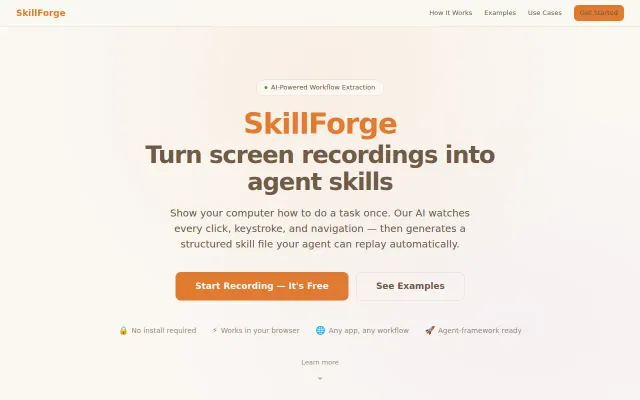
It records you doing a task, then auto-extracts clicks, keystrokes and navigation into a human-editable, step-by-step workflow and a SKILL.md you can feed to agent frameworks — that demo-to-skill UX is a real 'oh nice' moment. The landing page shows practical examples (spreadsheet entry, research, crypto checks) and an inline editor, but I want clarity on robustness: how it handles dynamic selectors, cross-app gestures, and sensitive data in recordings.
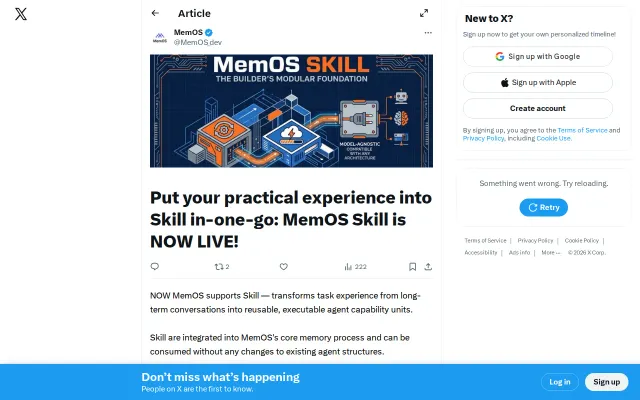
MemOS turns long-running conversations into reusable, load-on-demand 'Skills' that agents can call during task execution — a clear attempt to move beyond one-shot context into durable task logic. It’s an interesting engineering abstraction and nice to see an API-first demo, but the landing material glosses over crucial details like skill validation, deduplication, and safeguards against propagating bad agent behavior; show me metrics or human-in-the-loop tooling and this gets a lot more compelling.
STIX ontology and threat actor alias resolution beat Mem0 and Graphiti for CTI.
Production-hardened agent framework with Docker isolation, but Openclaw and n8n already saturate automation.